Changing an order
Elena has a noodle order scheduled for Friday at Lantern Noodle Bar. She asks Iris, her personal agent, to add a dessert and move the delivery to Sunday. Lantern makes the change after Elena has read the exact terms and approved them, and at no point does Iris hold her password or decide for her.
This page follows that request screen by screen, on Iris's side and on Lantern's. Every screenshot is from the live lab, taken on 26 November 2026.
Who does what
| Who | What they do in this process |
|---|---|
| Elena, the customer | Says what she wants in her own words, signs in on Lantern's page, and approves the change once she has read it. |
| Iris, her agent | Reads what Lantern publishes, reads the order once Elena allows it, and asks Lantern for the change. |
| Lantern, the company | Says what agents may do, shows its own consent page, sets the terms and the price, and makes the change it approved. |
Step by step
Pick the company
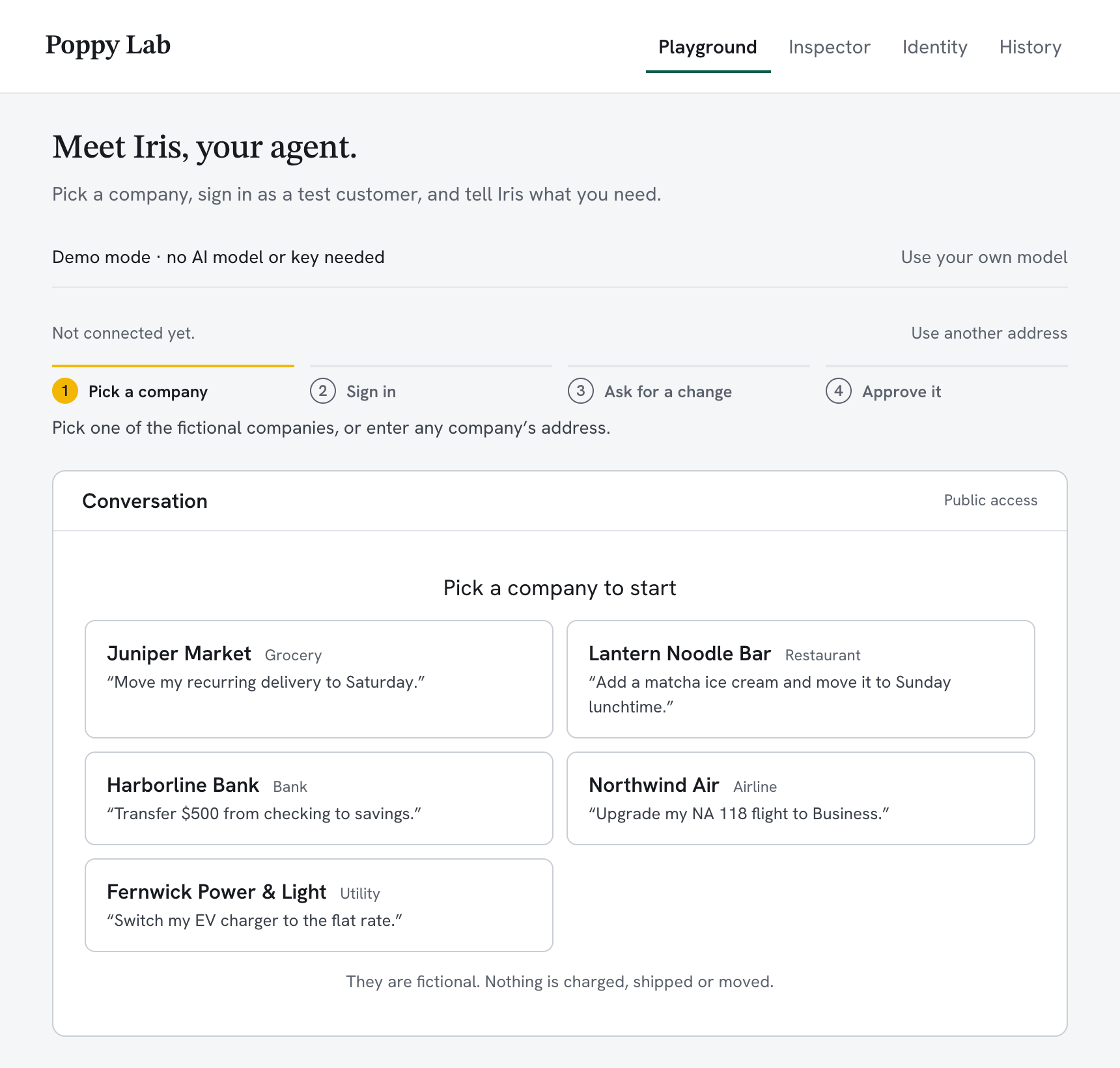
Iris starts with nothing but the company's address. Elena tells Iris which company she wants to deal with. Iris needs only its web address. From that address it fetches one public file in which Lantern says who it is, what an agent can do there and how a customer signs in.
Lantern wrote that file. Nothing about Lantern is built into Iris, so the same agent works with any company that publishes one.
What travelled
Iris made a handful of public requests and sent no credentials with any of them: the company's description, the description of its sign-in service and the list of its API operations.
GET https://food-demo.poppylab.dev/.well-known/poppy.jsonOne task, request by request shows the responses in full.
Ask what is public
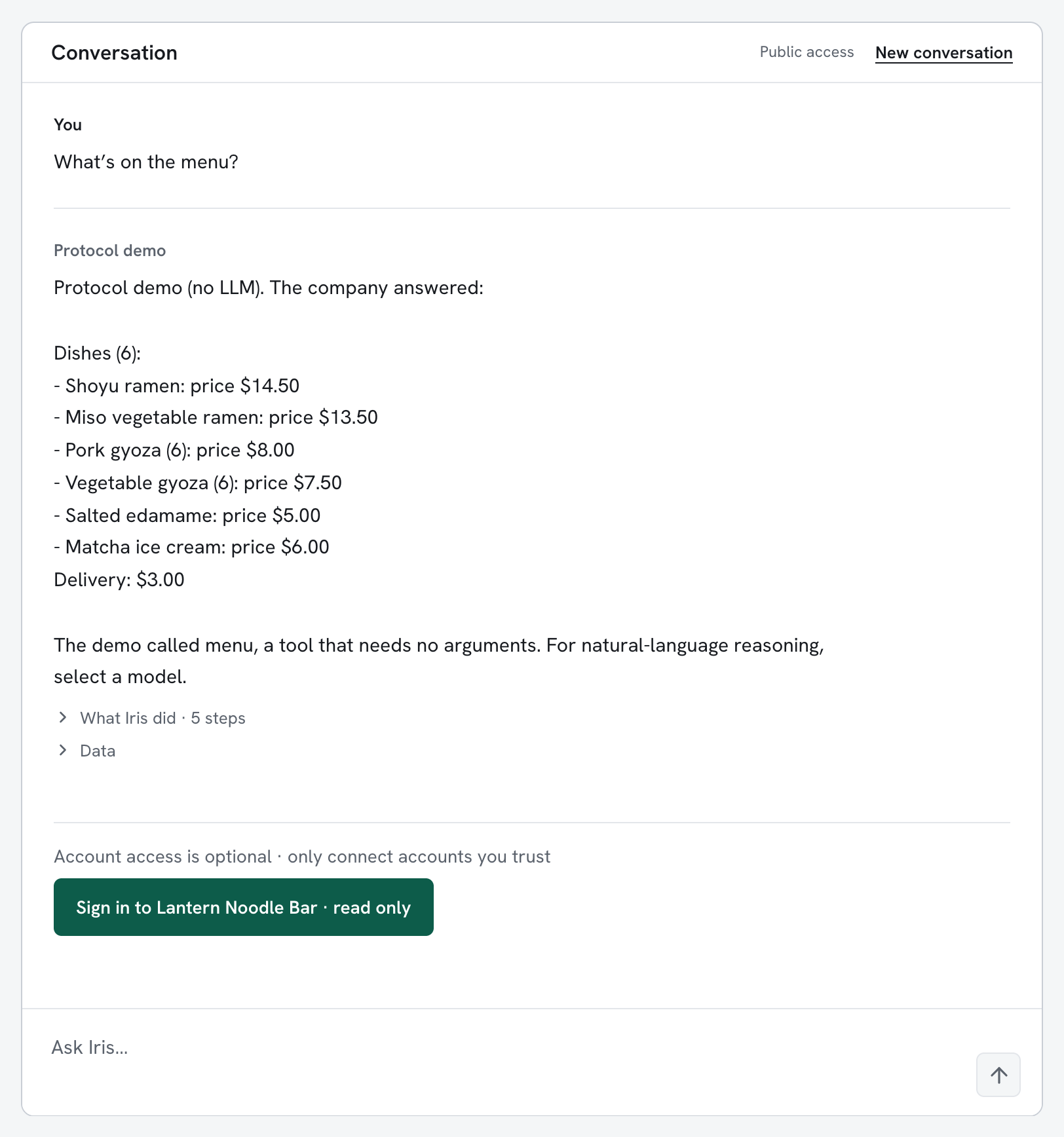
The menu is public, so Iris can read it before Elena signs in. Before she signs in, Elena asks what is on the menu. Lantern answers, because it decided that the menu and the delivery slots are public. Iris has no access to her account yet, and the green button under the answer is how she would give it.
The lab runs here in demo mode, without an AI model, so the answer is the company's data set out as plain lines. With a model connected Iris would answer in sentences. The requests to Lantern are the same either way.
What travelled
Iris opened a session with Lantern, which tells the company which agent is calling and for which of its users, without saying who that user is. Then it read the menu.
Started a Poppy Session, signed out
Read /poppy/tasks
Found 5 API tools at the Company
Read /api/menu
Sign in at Lantern
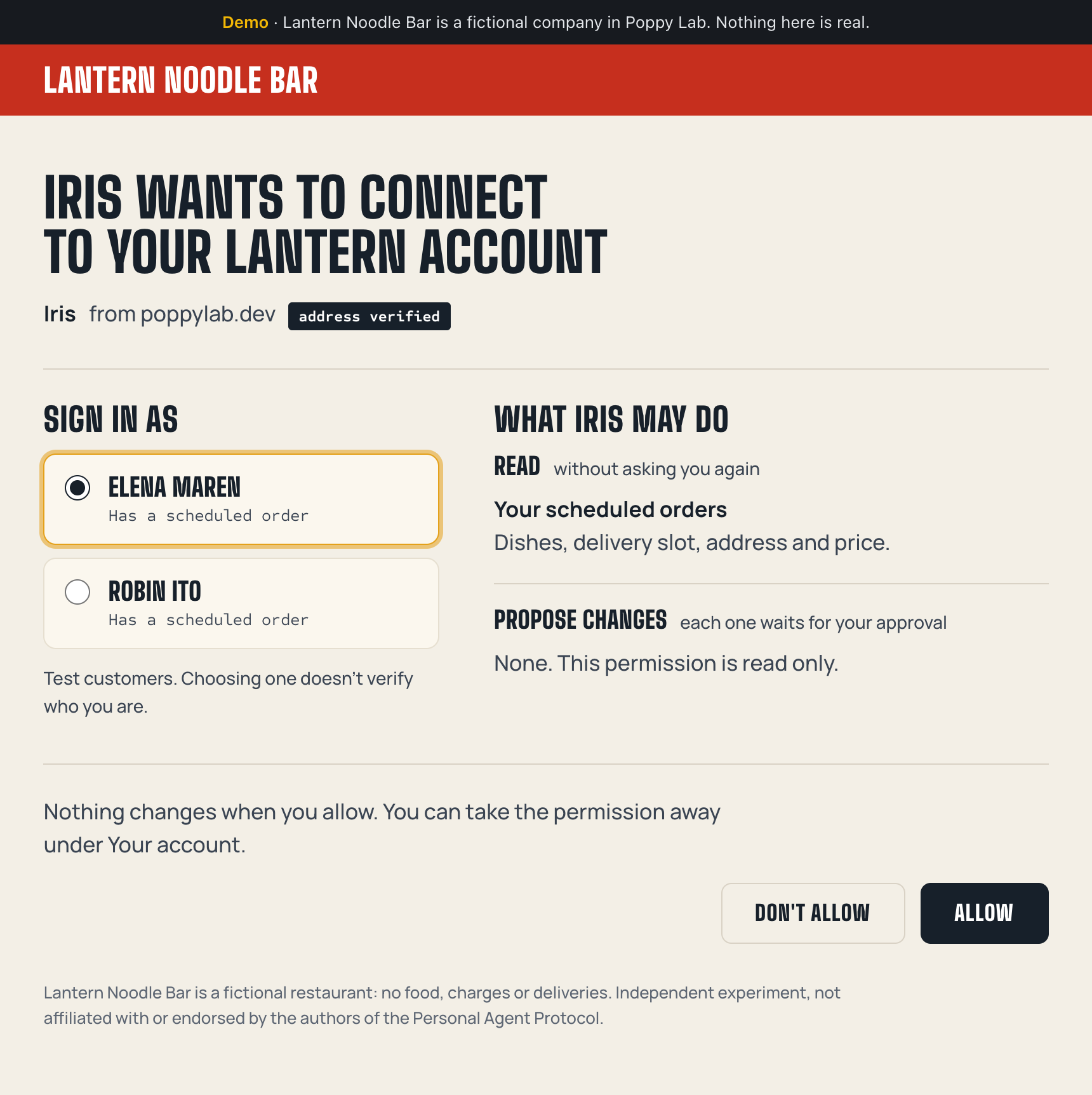
This page belongs to Lantern. Iris only opened it. Signing in happens on Lantern's website, in Lantern's design and in its words. The page says which agent is asking and what it would be allowed to do: see the scheduled orders, and nothing else. Elena chooses Allow.
Iris never sees a password. What it receives from Lantern is a permission tied to Iris itself, which Elena can withdraw at Lantern whenever she likes. The lab's companies have test customers and no passwords, which is why the page offers a list of names.
What travelled
Iris sent the sign-in request to Lantern directly and opened the consent page with a reference to it, so the request cannot be altered in the browser. After Elena allowed it, Lantern sent the browser back to Iris with a one-time code, and Iris exchanged the code for an access token bound to its own key.
Request Who makes it POST /oauth/parIris GET /oauth/authorizeand the consentElena POST /oauth/tokenIris Iris reads the order
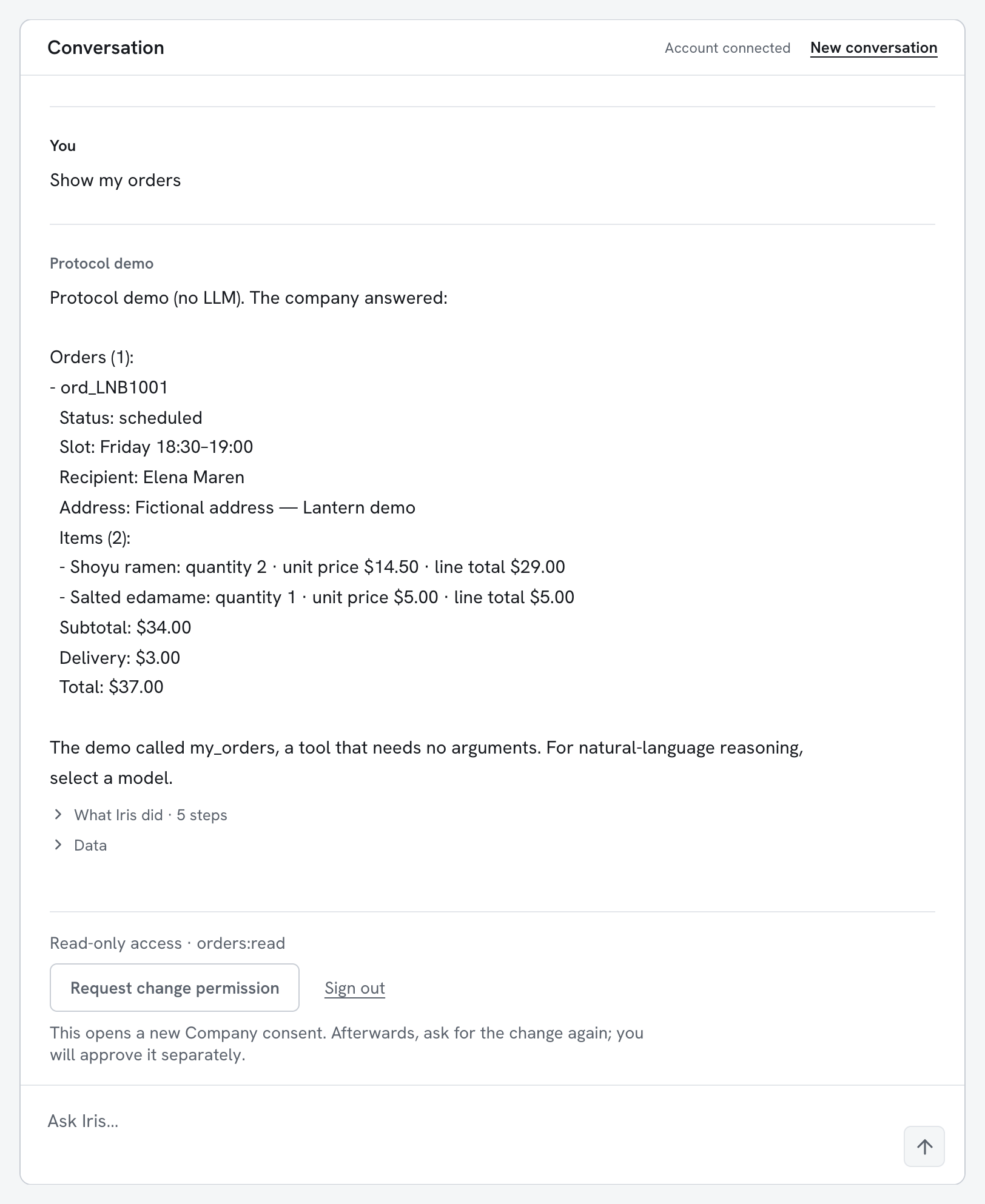
With read-only access Iris can see the order and cannot propose a change to it. Back in the conversation, Elena asks for her orders and Iris reads them from Lantern: one order for Friday evening, 37 dollars.
The line under the answer states what Iris may do at this point: read-only access. To change anything Elena has to give a second, separate permission, which is what the Request change permission button asks for.
What travelled
Started a Poppy Session, signed in
Read /api/account/orders
The request carried the access token from the sign-in. Lantern checked that the token allows
orders:readbefore it answered.The same order at Lantern
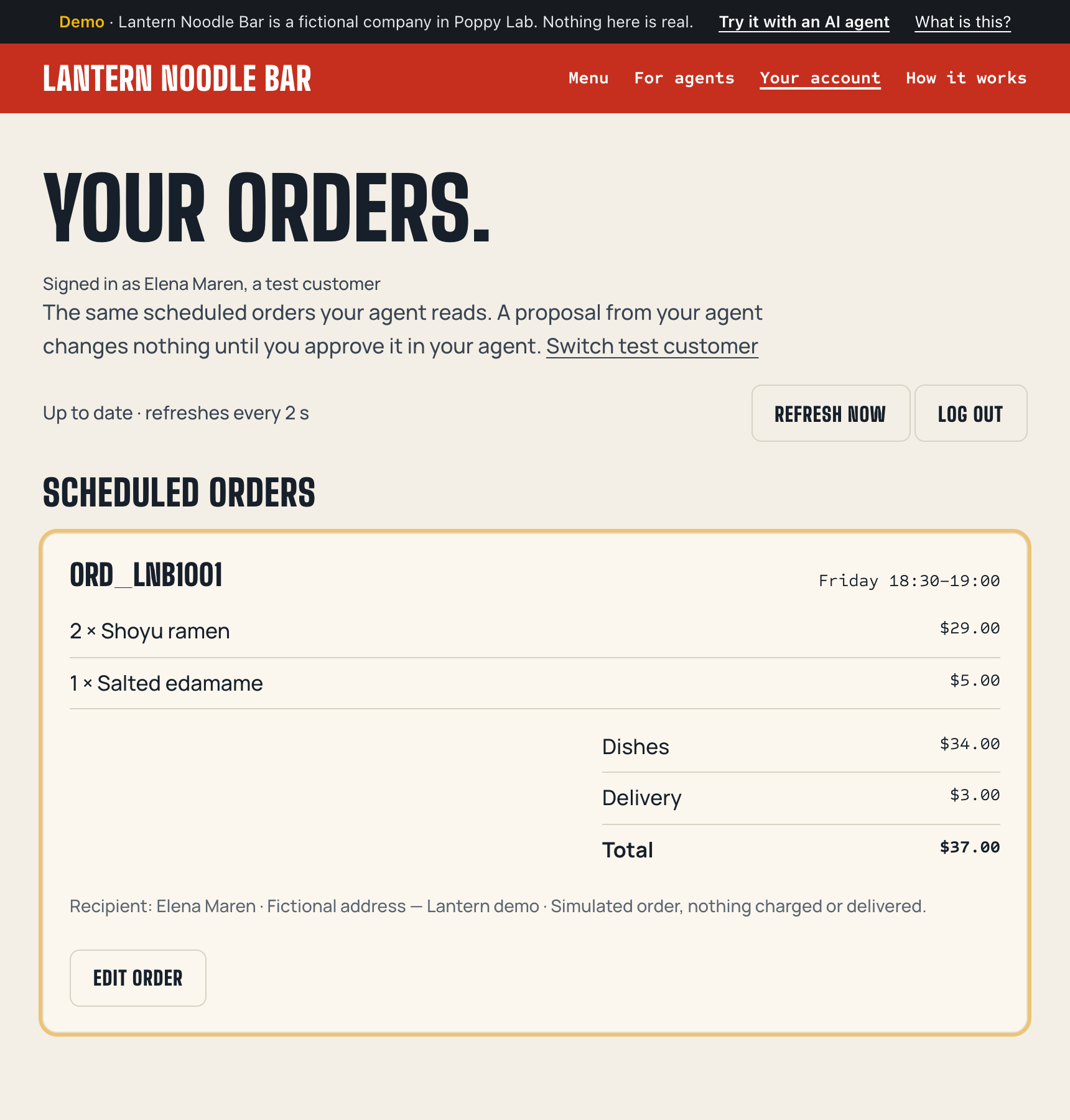
Lantern's own website shows the customer the order the agent just read. Lantern's website shows Elena the same order. The agent and the website read one record, kept by Lantern. Iris keeps no copy that could drift from it.
Allow Iris to propose changes
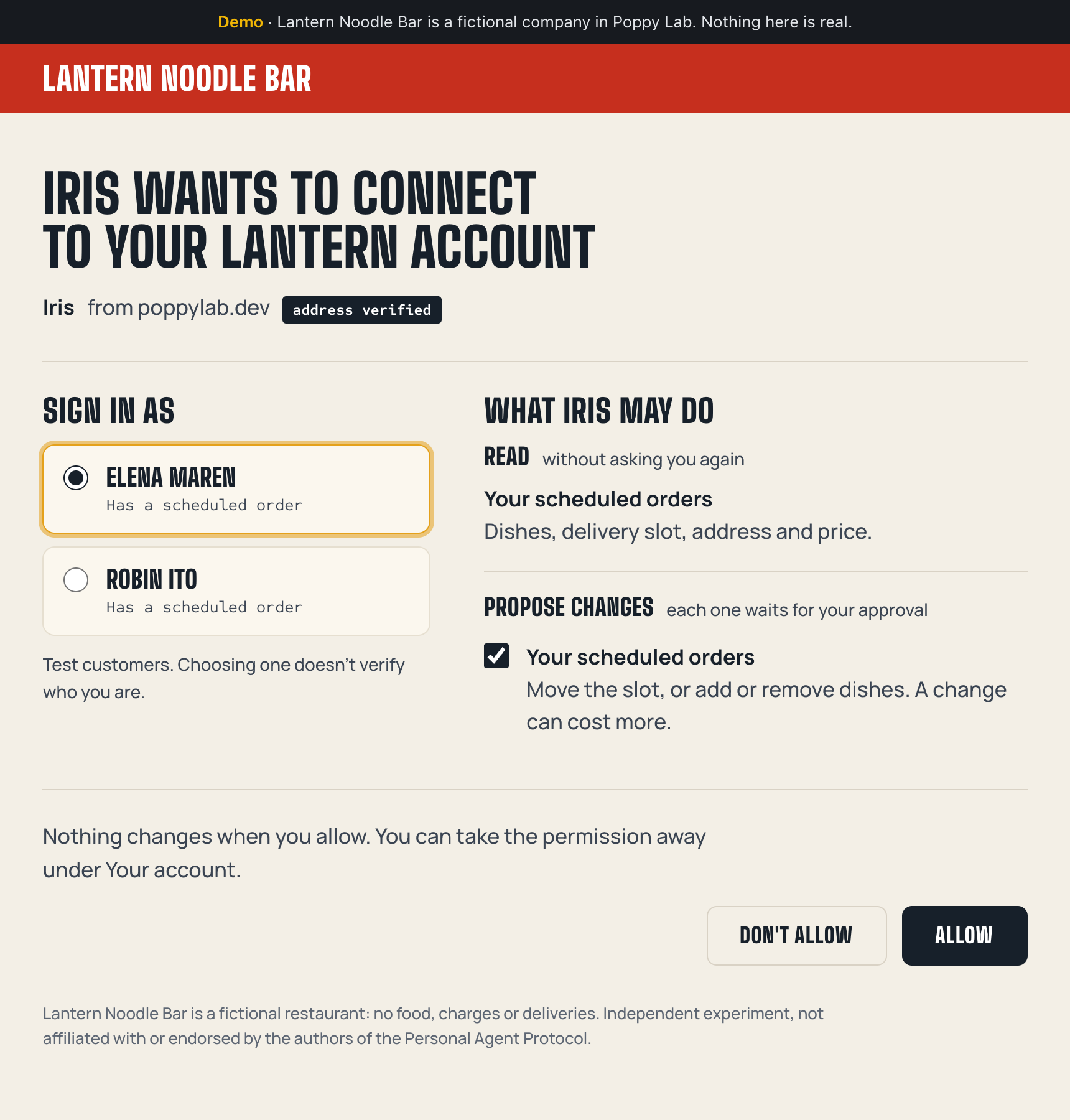
The second consent adds one permission, named in Lantern's words. Elena presses Request change permission and Lantern's page opens again. This time it names one more thing Iris could do: propose changes to scheduled orders. The permission lets Iris ask. Each change will still need Elena's approval.
Lantern decides how its permissions are split and how each one is described. A bank or an airline would draw the lines elsewhere.
Ask for the change
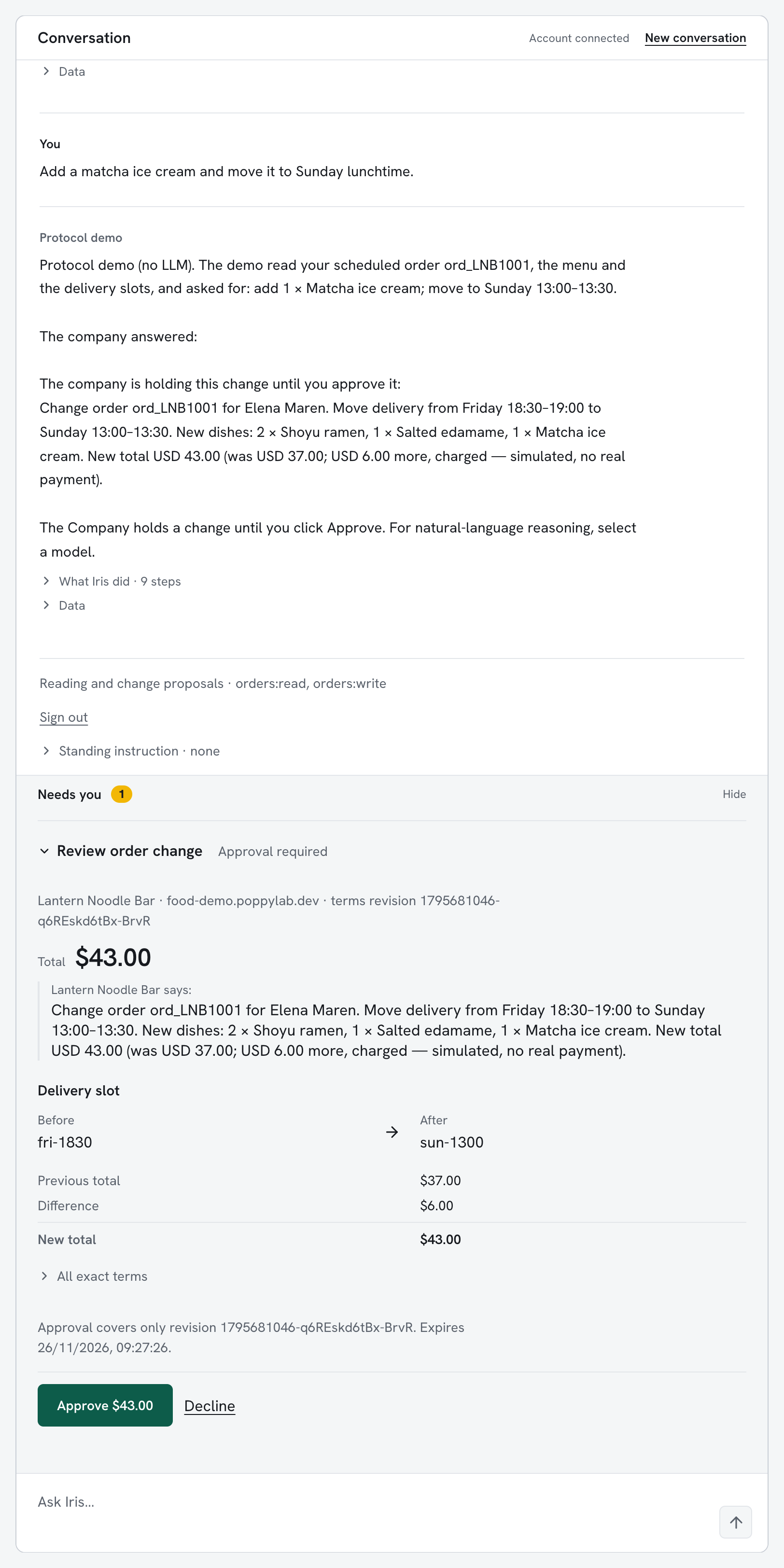
Lantern has not changed anything. It answered with terms that wait for Elena. Elena types what she wants: "Add a matcha ice cream and move it to Sunday lunchtime." Iris reads the menu, the delivery slots and the order, works out which dish and which slot she means, and asks Lantern for that change.
Lantern does not make it. It answers that the change needs the customer's approval and sends back the terms it would apply. Iris shows them in a panel called Needs you.
What travelled
Read /api/menu
Read /api/account/orders
Read /api/delivery-slots
Sent a request to /api/account/orders/ord_LNB1001/changes
Asked for your approval; nothing was done yet
Lantern's answer to the request, as Iris received it:
{
  "status": "approval_required",
  "operation_id": "op_T28R3qgsjNNlk-qUOdUM-2cL",
  "summary": "Change order ord_LNB1001 for Elena Maren. Move delivery from Friday 18:30–19:00 to Sunday 13:00–13:30. New dishes: 2 × Shoyu ramen, 1 × Salted edamame, 1 × Matcha ice cream. New total USD 43.00 (was USD 37.00; USD 6.00 more, charged — simulated, no real payment).",
  "terms": {
    "order_id": "ord_LNB1001",
    "order_version": 1,
    "from_slot": "fri-1830",
    "to_slot": "sun-1300",
    "lines": { "shoyu-ramen": 2, "edamame": 1, "matcha-ice": 1 },
    "before_total_cents": 3700,
    "new_total_cents": 4300,
    "price_difference_cents": 600,
    "currency": "USD",
    "payment": "Simulated card on file — no real charge"
  },
  "expires_at": "2026-11-26T08:27:26.713Z"
}
Read what you are approving
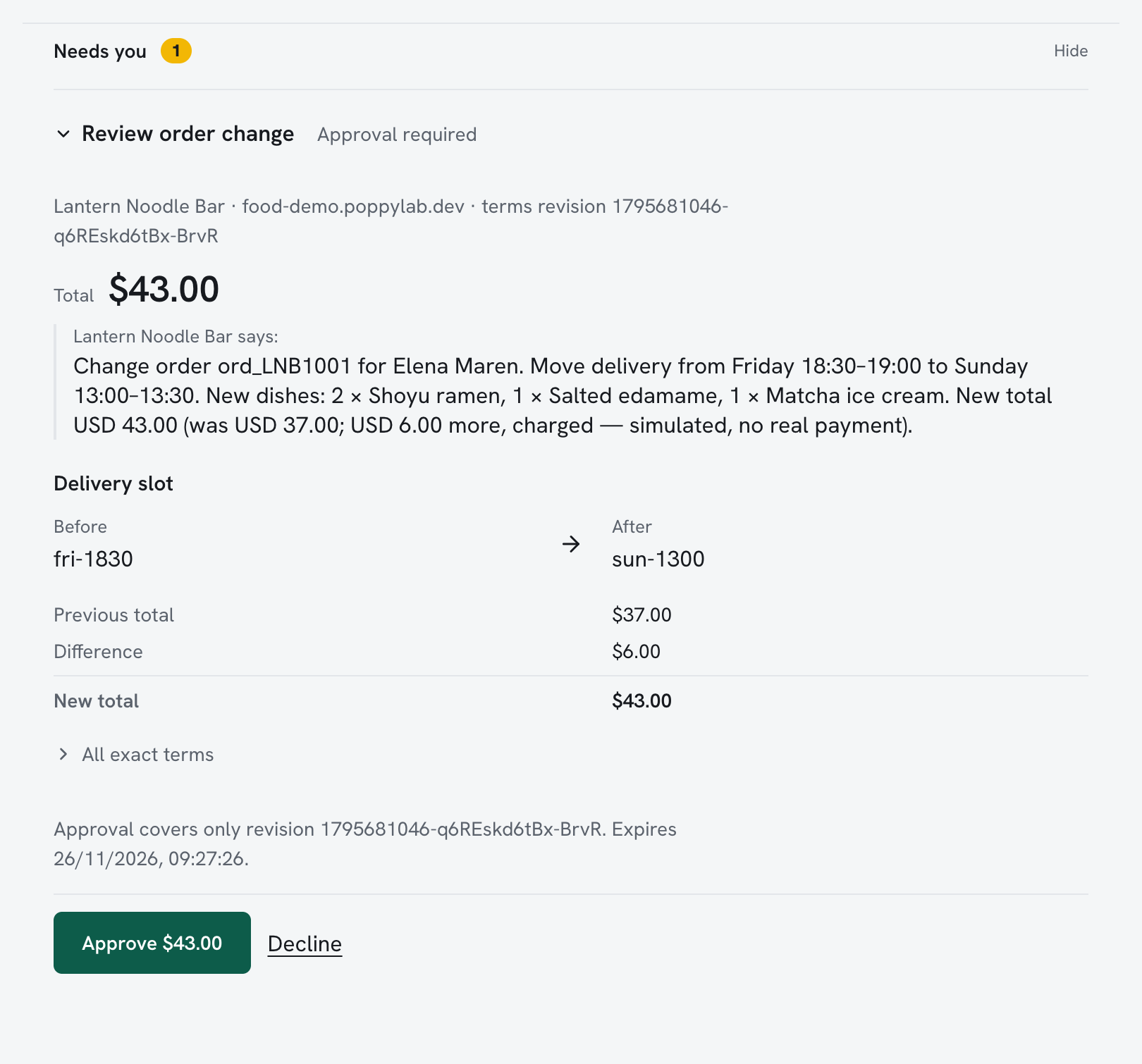
The terms come from Lantern. Iris shows them and adds nothing of its own. The panel shows what Lantern will do if Elena approves: the new delivery slot, the dishes, the new total and the difference from the old one. The paragraph that begins "Lantern Noodle Bar says" is the company's own description, shown as written.
An approval covers these terms and no others. If Lantern's price or the order changed in the meantime, Lantern would send new terms and Elena would be asked again. The approval also expires: this one was good for ten minutes.
What travelled
No request was made in this step. The terms were already in Lantern's answer in step 7, and they stay on Elena's screen until she decides.
Approve
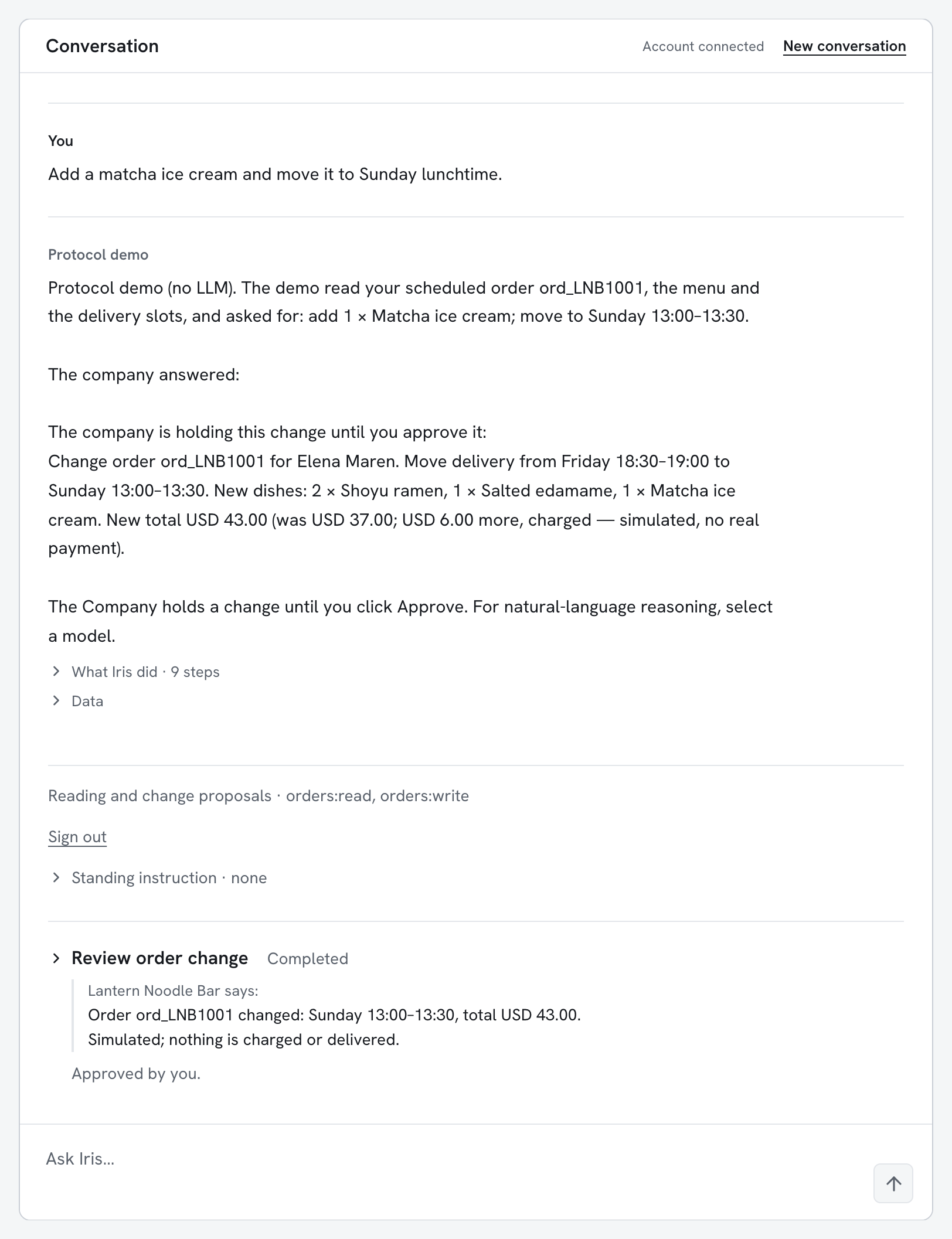
Lantern made the change when the approval arrived, and said so. Elena presses Approve. Iris sends Lantern the same request again, this time with her approval attached. Lantern checks that the approval matches the terms it offered, makes the change and confirms it: the order is now for Sunday and costs 43 dollars. The proposal stays in the conversation as a finished entry, with Lantern's confirmation and the line "Approved by you."
The approval is something Elena gives by pressing the button. A sentence in the conversation cannot stand in for it, whether Elena writes it or the model does.
What travelled
The same request as in step 7, with a
Poppy-Approvalheader that names the operation, the terms revision and who approved. Approvals with Operations describes the header and what the company checks.Check the order at Lantern
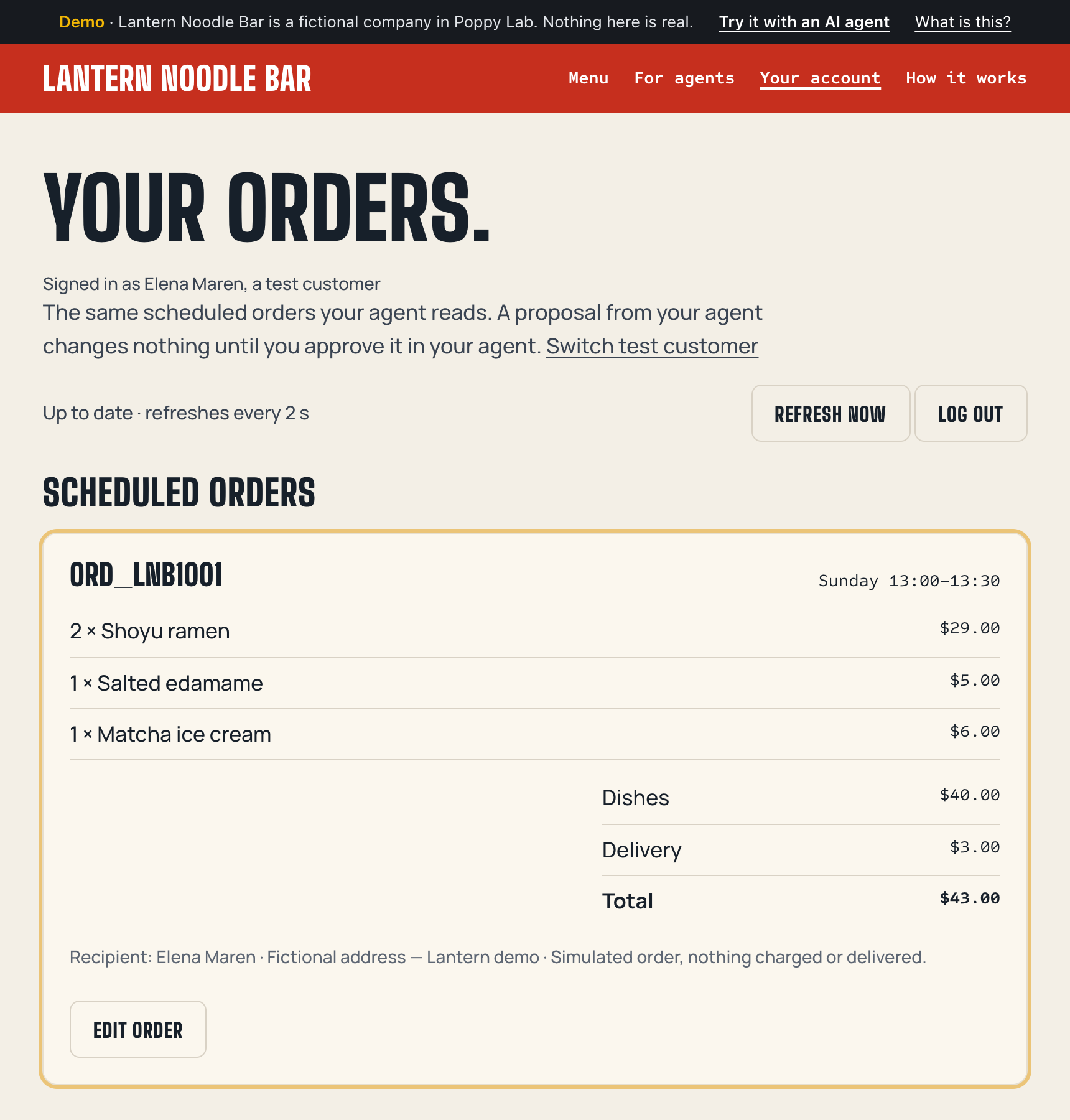
The changed order on Lantern's website, a few seconds later. Lantern's website shows the order as it now stands: Sunday lunchtime, three dishes, 43 dollars.
See what the agent did
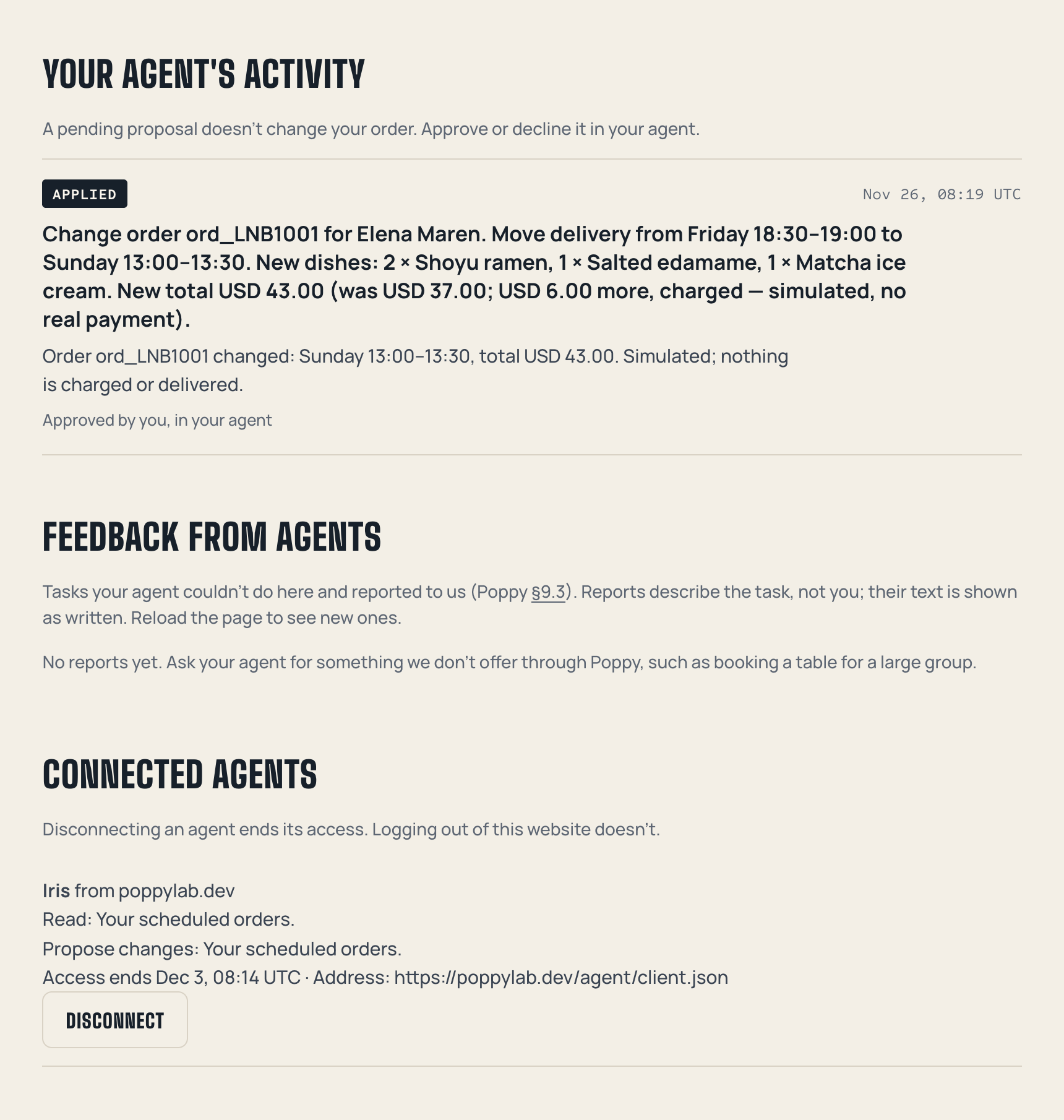
Lantern shows the customer what her agent asked for, who approved it, and which agents are connected. Lower on the same page, Lantern lists what Elena's agent has asked for recently. The entry for this change says it was applied, at what time, and that Elena approved it in her agent. A customer who wonders how an order changed finds the answer on the company's site. Lantern keeps the entry: the screenshot is from fifteen minutes after the approval, after Iris had read the order once more.
Under Connected agents, Lantern lists Iris in the words of its consent page: what it may read, what it may propose, and when its access ends. The Disconnect button under the entry is where Elena takes the permission away.
What Lantern controls
Lantern stays in charge of its own business throughout.
- It decides what an agent can read without an account and what needs the customer to sign in.
- The sign-in and both consents happen on its own pages, with its own wording.
- It computes the terms and the price. The agent cannot propose a total.
- It makes a change only when the customer's approval arrives, and only for the terms it offered.
- It shows the customer what her agent asked for recently, what was applied and who approved it.
For the technical reader
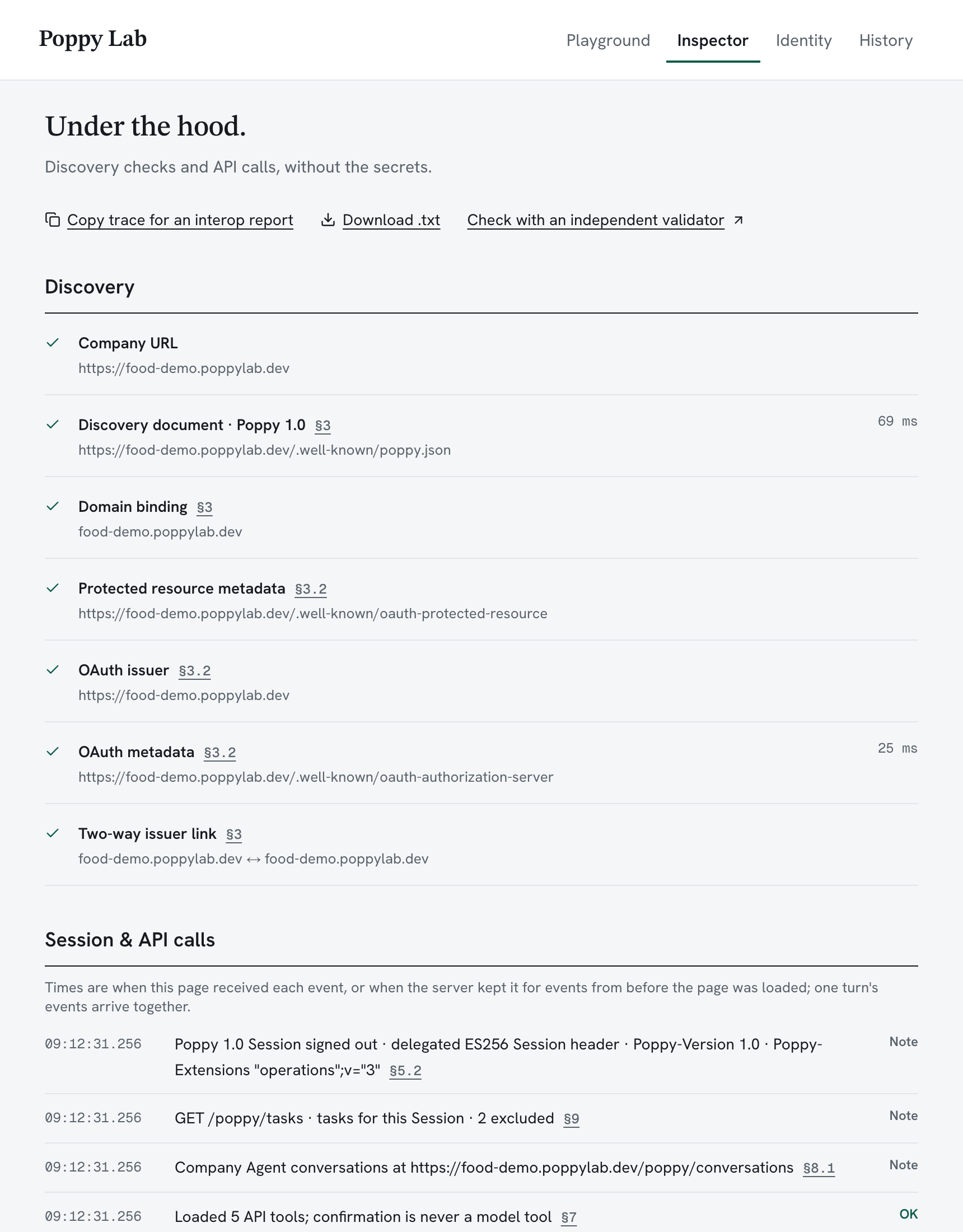
The Inspector view of the playground lists every check and every call behind the screens above, and the trace can be downloaded. The calls stay with the conversation, so they are listed again after a reload or when the conversation is opened from History. One task, request by request walks through the same kind of change with each request and response written out.