Moving money
Elena banks at Harborline Bank. She asks Iris, her personal agent, to move 1,000 dollars from her checking account to her savings account, and then to pay a supplier she has paid before. Harborline moves the money each time after Elena has read the exact terms and approved them. Later she asks for a payment her balance does not cover, and Harborline refuses it.
This page follows those three requests screen by screen, on Iris's side and on Harborline's. Every screenshot is from the live lab, taken on 26 November 2026. Harborline is fictional, and no real money exists or moves.
Who does what
| Who | What they do in this process |
|---|---|
| Elena, the customer | Says what she wants in her own words, signs in on Harborline's page, and approves each transfer and payment after reading it. |
| Iris, her agent | Reads the accounts and the saved recipients once Elena allows it, and asks Harborline for the transfer or the payment. |
| Harborline, the company | Shows its own consent page, works out the terms and the resulting balances, moves the money once approved, and refuses a request its rules do not allow. |
Step by step
The accounts at Harborline
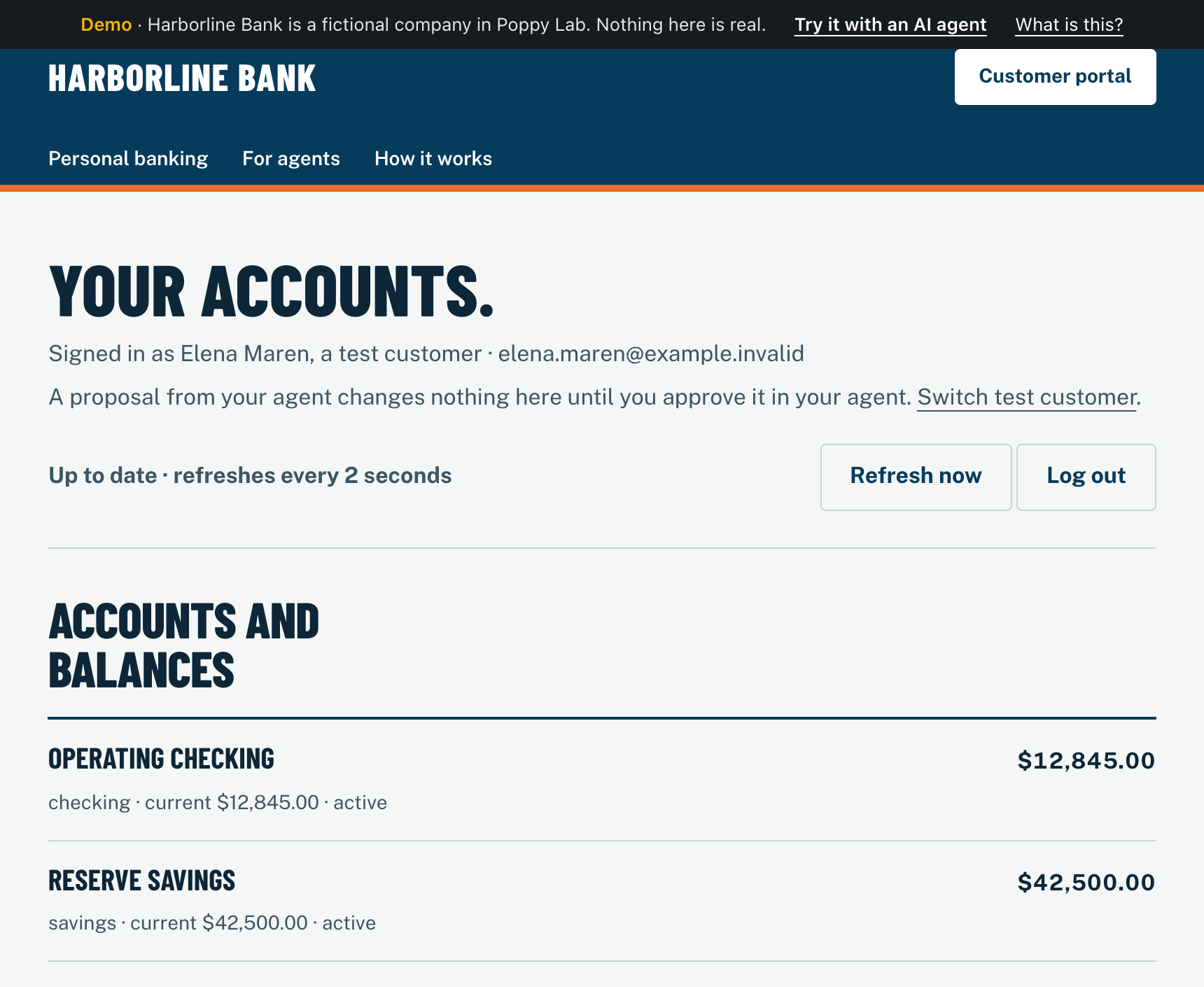
Elena's two accounts on Harborline's own website, before she asks for anything. Elena has two accounts at Harborline: 12,845 dollars in Operating checking and 42,500 dollars in Reserve savings. Harborline keeps these records, and its website shows them to her.
Everything Iris reads or asks for on this page refers to these two accounts. Iris keeps no balance of its own.
Sign in and allow Iris to propose
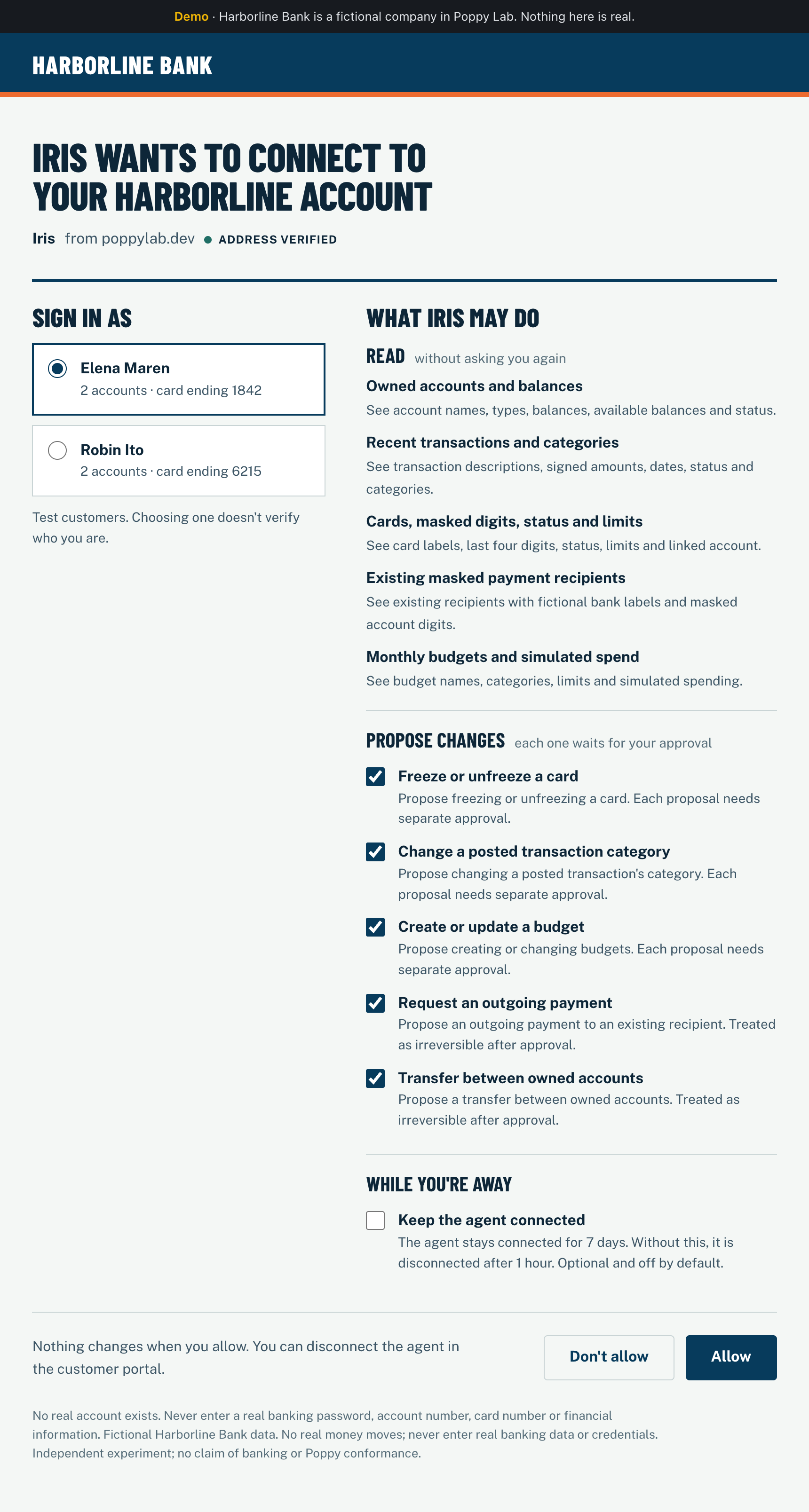
This page belongs to Harborline. Each kind of change has its own box. Elena picks Harborline in Iris and signs in on Harborline's own page. The bank asks her twice, and the first page lets Iris read her accounts. The second, in the screenshot, opens with Elena already chosen and adds the changes Iris may propose. Elena can untick any of them, and payments and transfers are separate boxes.
The page says that each change waits for her approval. The permission lets Iris ask for a transfer, and every transfer still comes back to Elena before any money moves. Iris never sees a password.
A last box, unticked, would keep Iris connected for seven days. Without it Harborline disconnects the agent after an hour. Changing an order shows the two consents one at a time at another company.
What travelled
After both consents Iris held a permission from Harborline with these scopes, which are the bank's names for what it allows. The last two are the ones this page uses.
accounts:read  transactions:read  cards:read  recipients:read  budgets:read
cards:write  transactions:write  budgets:write
payments:request  transfers:request
Ask for the transfer
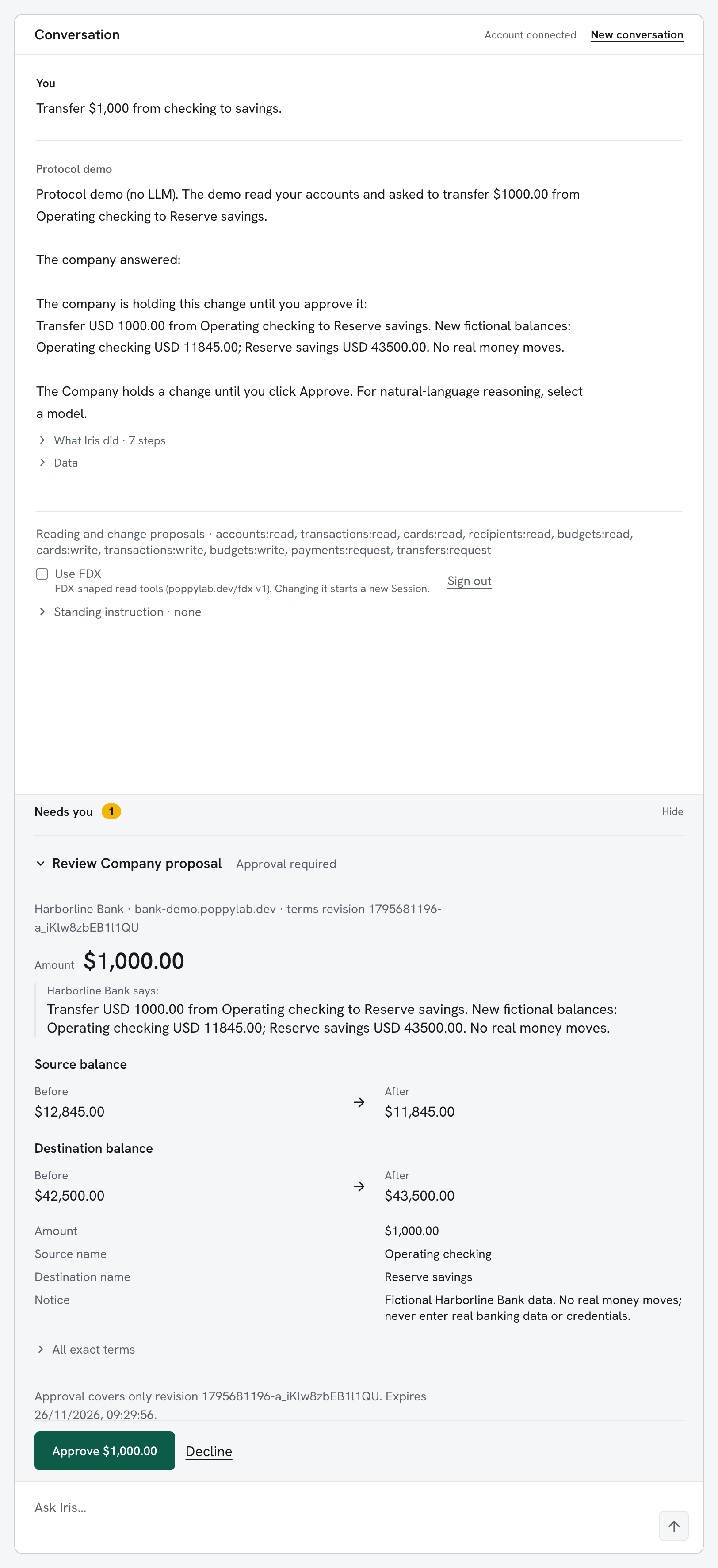
Harborline has moved nothing. It answered with terms that wait for Elena. Elena types "Transfer $1,000 from checking to savings." Iris reads her accounts, works out which two she means, and asks Harborline for that transfer.
Harborline does not make it. It answers that the transfer needs the customer's approval and sends back the terms it would apply, including the balance each account would have afterwards. Iris shows them in a panel called Needs you, with the amount first and each balance before and after.
The lab runs here in demo mode, without an AI model, so the answer is the company's data set out as plain lines. With a model connected Iris would answer in sentences. The requests to Harborline are the same either way.
What travelled
Started a Poppy Session, signed in
Read /poppy/tasks
Company Agent conversations at https://bank-demo.poppylab.dev/poppy/conversations
Found 11 API tools at the Company
Read /api/account/accounts
Sent a request to /api/account/transfers
Asked for your approval; nothing was done yet
Harborline's answer to the request, as Iris received it:
{
  "status": "approval_required",
  "operation_id": "op_FCLXWbEyRrj51RgRibpjDNJe",
  "summary": "Transfer USD 1000.00 from Operating checking to Reserve savings. New fictional balances: Operating checking USD 11845.00; Reserve savings USD 43500.00. No real money moves.",
  "terms": {
    "source_account_id": "acc_HLB_A100",
    "destination_account_id": "acc_HLB_A200",
    "amount_cents": 100000,
    "idempotency_key": "KqH1PkPA_IZCQzErKNyH3h-GdE51Xlrr",
    "source_name": "Operating checking",
    "destination_name": "Reserve savings",
    "source_version": 1,
    "destination_version": 1,
    "source_balance_before_cents": 1284500,
    "source_balance_after_cents": 1184500,
    "destination_balance_before_cents": 4250000,
    "destination_balance_after_cents": 4350000,
    "currency": "USD",
    "notice": "Fictional Harborline Bank data. No real money moves; never enter real banking data or credentials."
  },
  "expires_at": "2026-11-26T08:29:56.868Z"
}
Read what you are approving
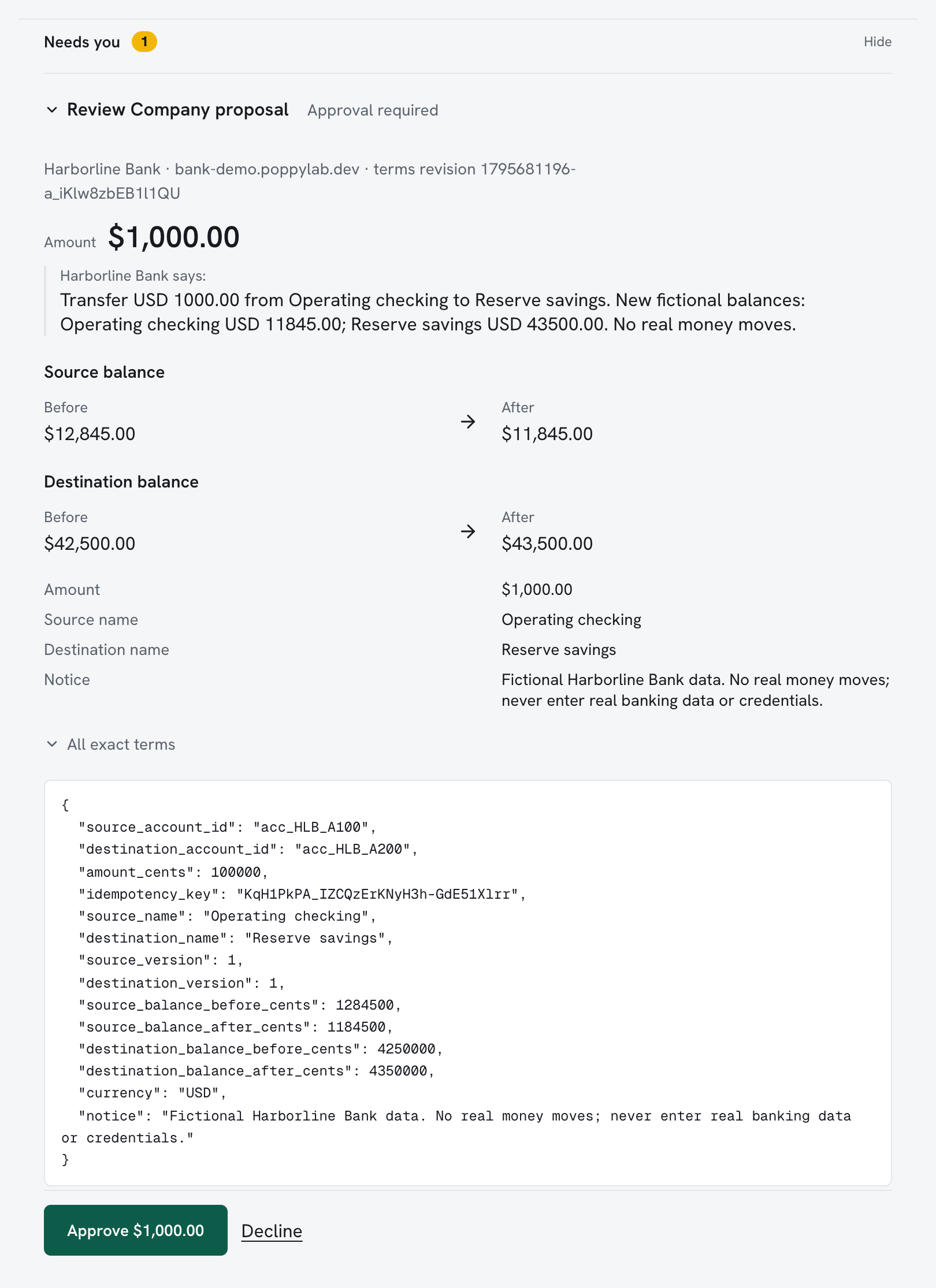
The terms come from Harborline. Iris shows them and adds nothing of its own. The panel shows what Harborline will do if Elena approves, and it leads with the amount. The paragraph that begins "Harborline Bank says" is the bank's own description, and the rows below it give each balance before and after and the two accounts by name. Harborline worked out the balances. Iris asked only for an amount and two accounts. The Approve and Decline buttons stay at the foot of the panel while the terms scroll above them.
Under All exact terms are the same facts as data, with the amount in cents. The line called
idempotency_keyis a label Iris made up for this one request. It lets Harborline recognise a repeat of the same request, so a transfer that was made is never made a second time.An approval covers these terms and no others, and this one was good for ten minutes. The terms name the balances the transfer starts from. If a balance changes before Elena approves, her approval no longer fits what Harborline would do. The bank moves nothing on it and answers with new terms for her to read.
What travelled
No request was made in this step. The terms were already in Harborline's answer in step 3, and they stay on Elena's screen until she decides. Approvals with Operations describes what a company checks when an approval arrives.
Nothing has moved yet
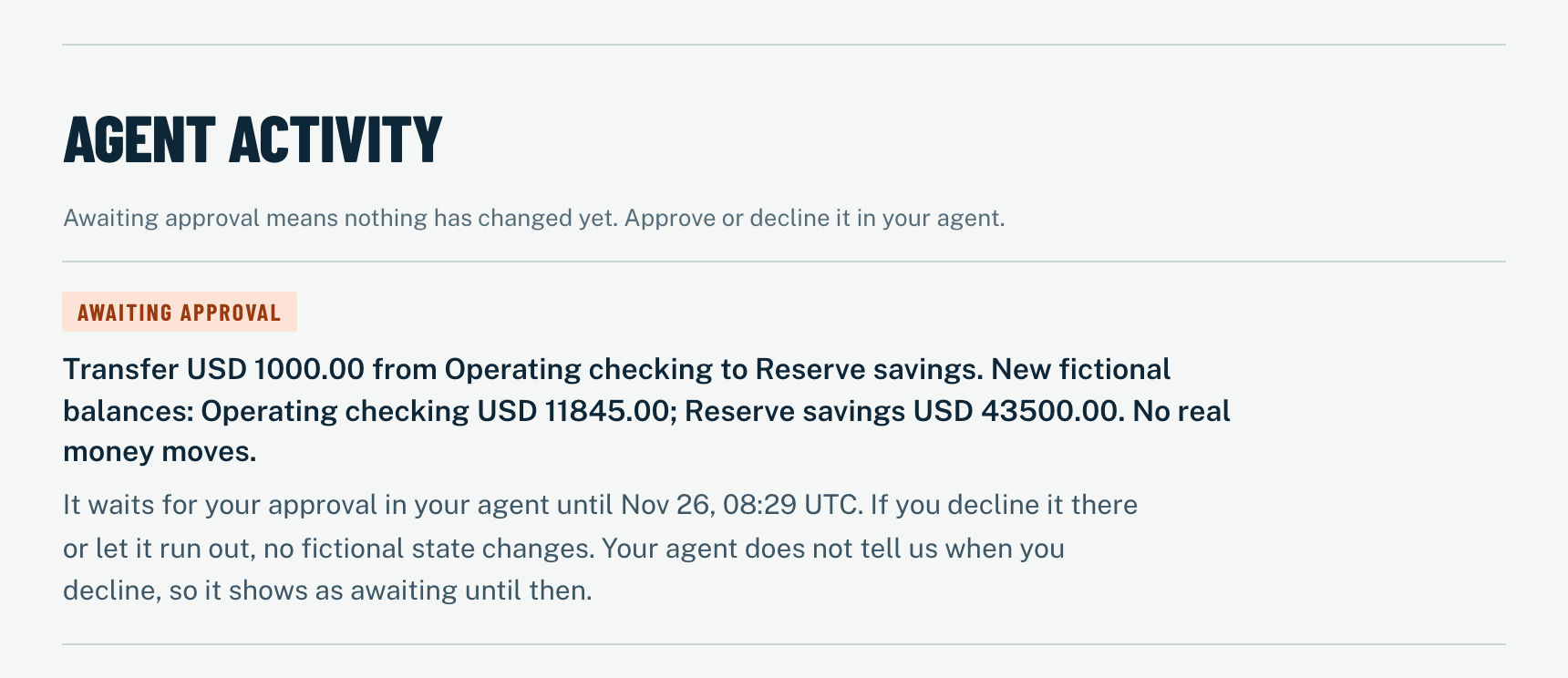
While the panel waits in Iris, Harborline's website shows the request as a proposal. While the panel waits, Harborline's website lists the request under Agent activity as awaiting approval, and says until when it waits. The balances at the top of the same page are still 12,845 and 42,500 dollars.
Elena could stop here. If she declines in Iris or lets the time run out, nothing changes at Harborline. Iris does not report a decline to the bank, so the website shows a declined proposal as awaiting until that time, and then as expired without change.
Approve
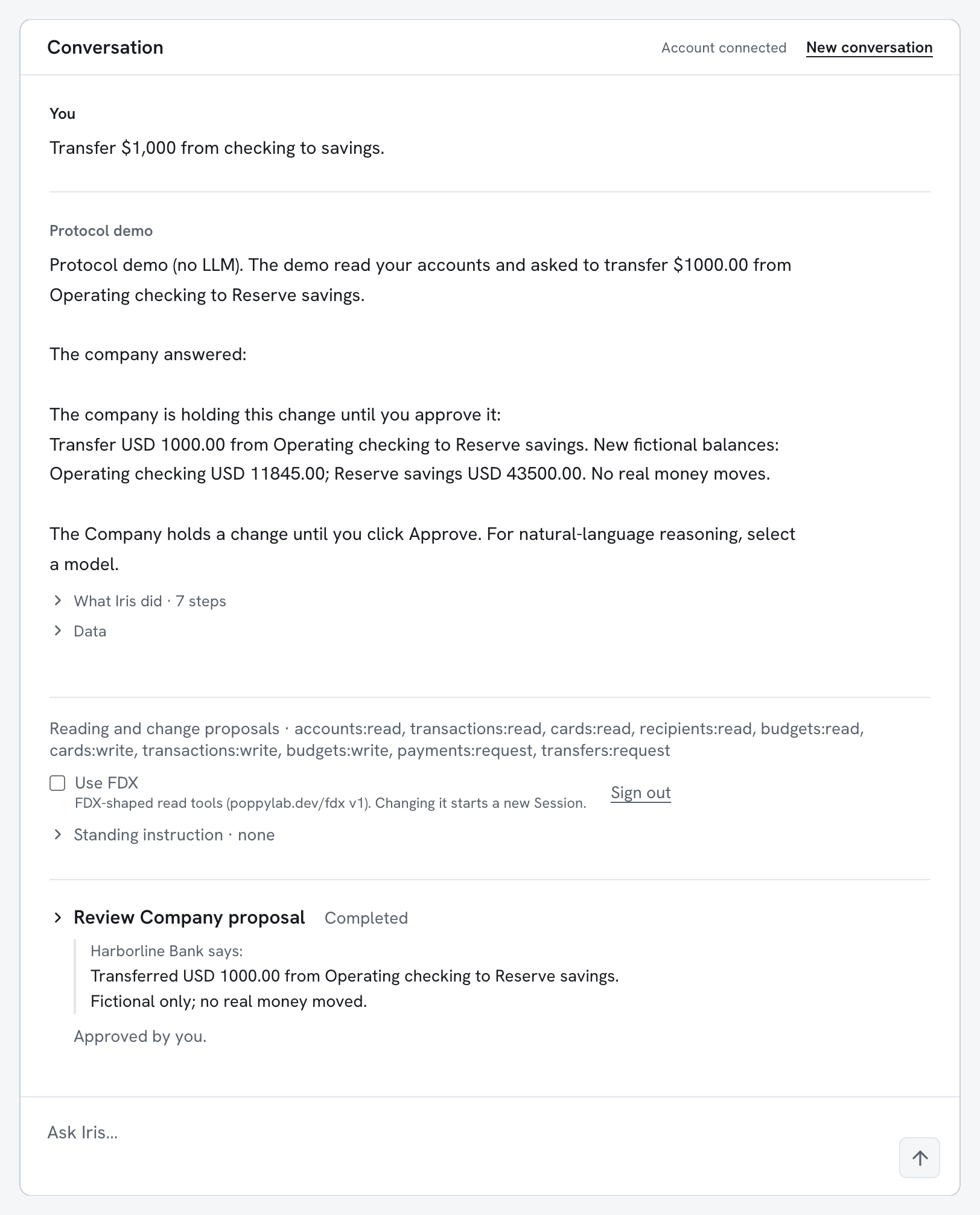
Harborline made the transfer when the approval arrived, and said so. Elena presses Approve $1,000.00. Iris sends Harborline the same request again, this time with her approval attached. Harborline checks that the approval matches the terms it offered, moves the money and confirms it. The entry in the conversation shows the bank's confirmation and who approved.
The approval is something Elena gives by pressing the button. A sentence in the conversation cannot stand in for it, whether Elena writes it or the model does.
What travelled
The same request as in step 3, with a
Poppy-Approvalheader that names the operation, the terms revision and who approved. Approvals with Operations describes the header.The balances at Harborline
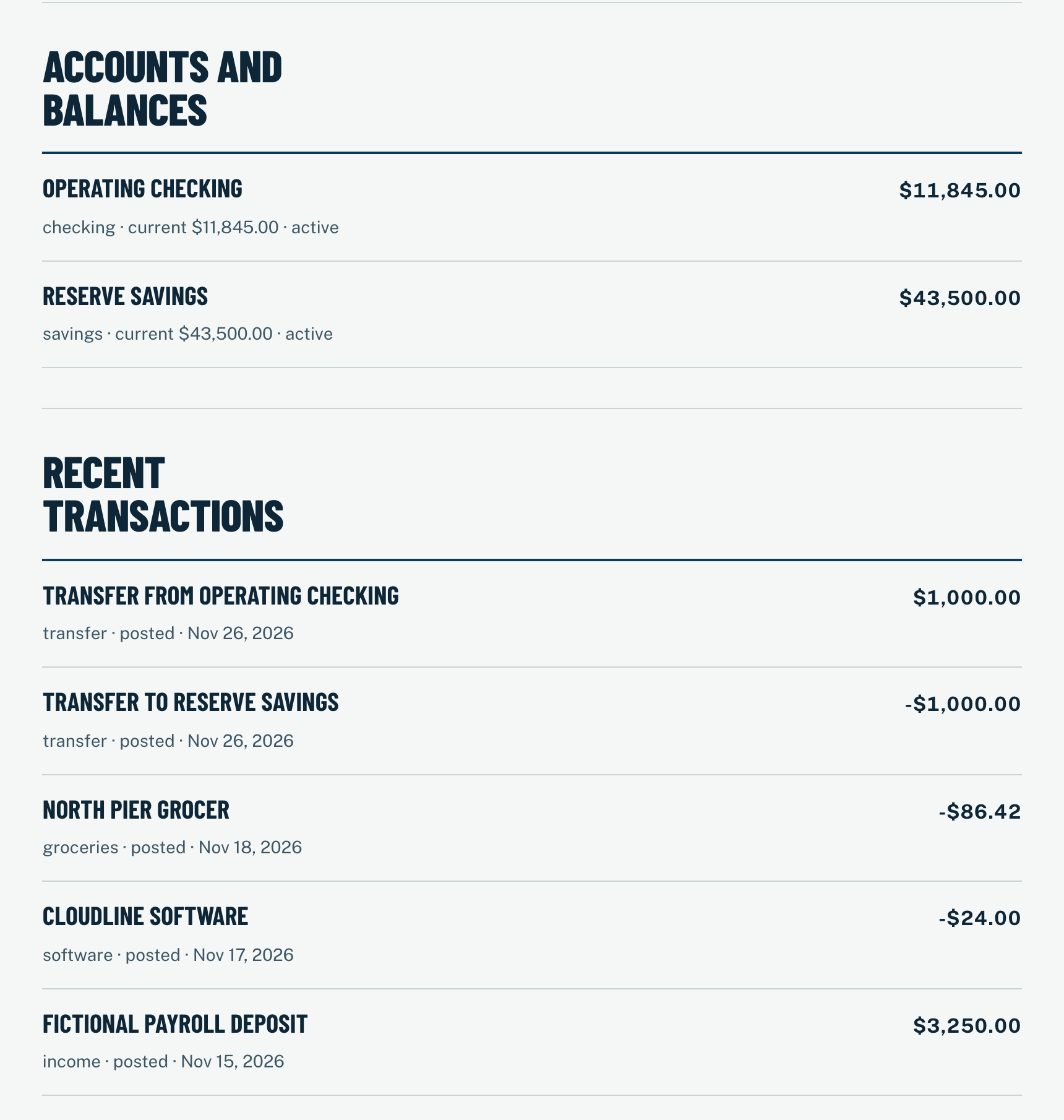
The two balances Elena approved, on Harborline's website a few seconds later. Harborline's website shows the accounts as they now stand: 11,845 dollars in checking and 43,500 dollars in savings, the two balances Elena read in the panel. The transfer appears twice in the recent transactions, once leaving checking and once arriving in savings.
Ask for a payment
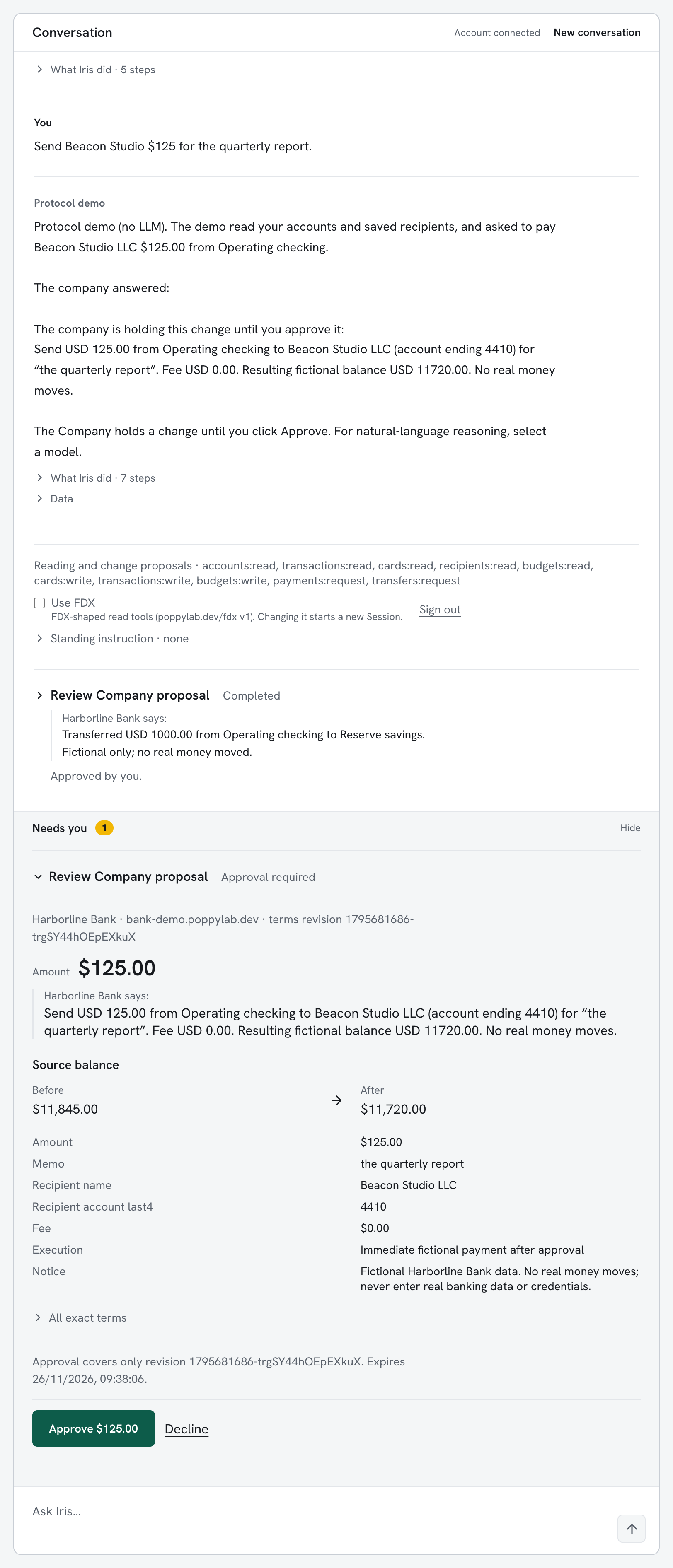
The terms of a payment name the recipient and repeat the memo in Elena's words. Next Elena types "Send Beacon Studio $125 for the quarterly report." Iris reads her accounts and her saved recipients, finds Beacon Studio LLC among them, and asks Harborline for the payment from checking. Her words after "for" travel as the memo.
Harborline answers with terms again, and the panel sets them out as rows: the amount, the balance before and after, the memo, the recipient by name with the last four digits of its account, and a fee of zero. The balance that would remain is 11,720 dollars. Elena can check that the recipient and the memo are the ones she meant before she approves.
Iris asks for payments only to a recipient Elena has already saved at Harborline. When she asked it to pay someone who is not among her active recipients, Iris asked who should be paid and sent nothing to the bank.
What travelled
Started a Poppy Session, signed in
Company Agent conversations at https://bank-demo.poppylab.dev/poppy/conversations
Found 11 API tools at the Company
Read /api/account/accounts
Read /api/account/recipients
Sent a request to /api/account/payments
Asked for your approval; nothing was done yet
The terms in Harborline's answer:
{
  "source_account_id": "acc_HLB_A100",
  "recipient_id": "rcp_HLB_A501",
  "amount_cents": 12500,
  "memo": "the quarterly report",
  "idempotency_key": "lPcA6J-4Q9sHf-AsKdJXVVJkLdLpy2oi",
  "source_account_version": 2,
  "source_balance_before_cents": 1184500,
  "source_balance_after_cents": 1172000,
  "recipient_name": "Beacon Studio LLC",
  "recipient_account_last4": "4410",
  "recipient_version": 1,
  "fee_cents": 0,
  "currency": "USD",
  "execution": "Immediate fictional payment after approval",
  "notice": "Fictional Harborline Bank data. No real money moves; never enter real banking data or credentials."
}
The payment at Harborline
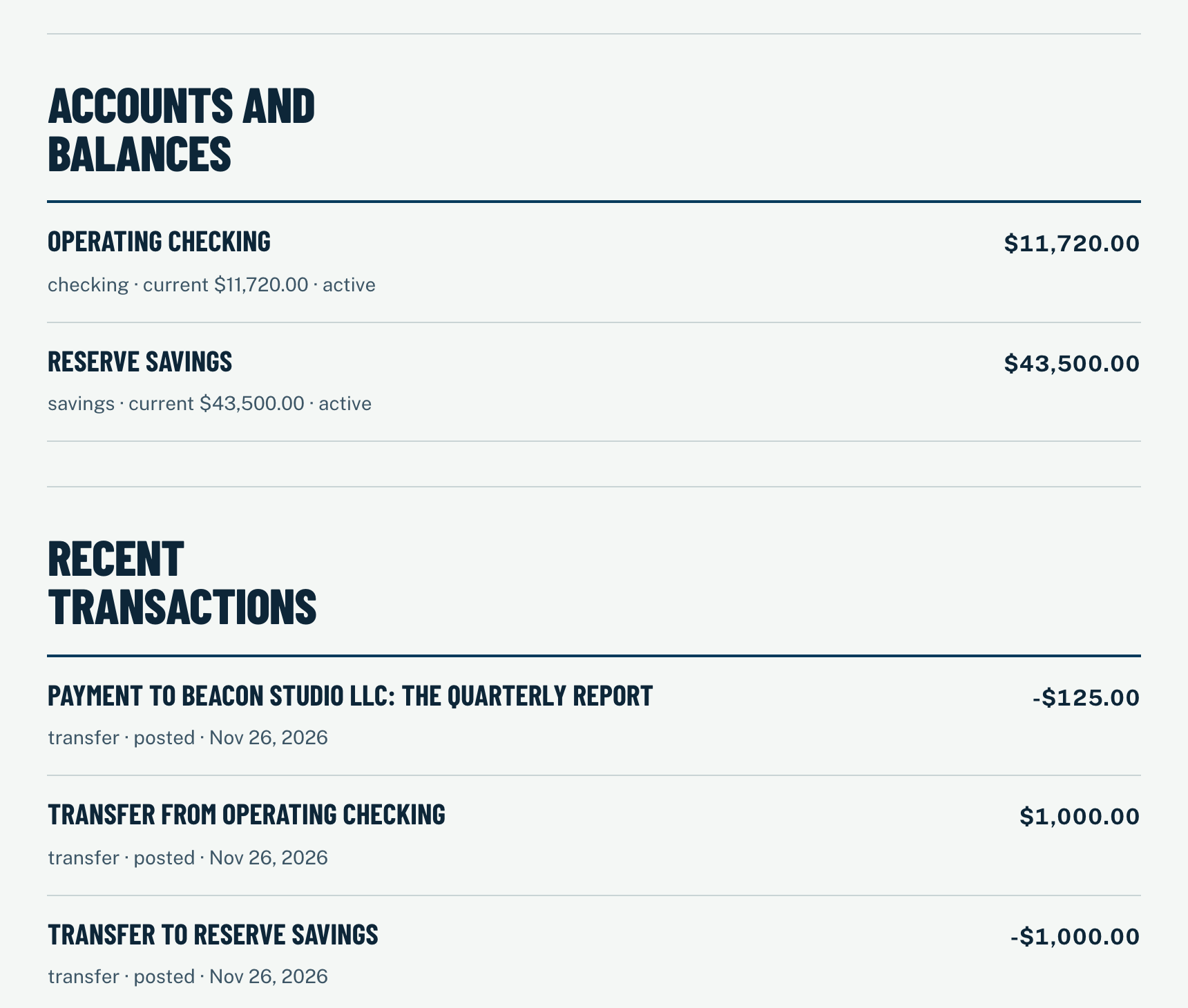
The payment in the account's history at Harborline, with the memo Elena wrote. Elena approves, and Harborline confirms to Iris that it sent 125 dollars to Beacon Studio LLC. On Harborline's website the payment is the newest line of the account's history, with the memo, and checking stands at 11,720 dollars.
When the bank says no
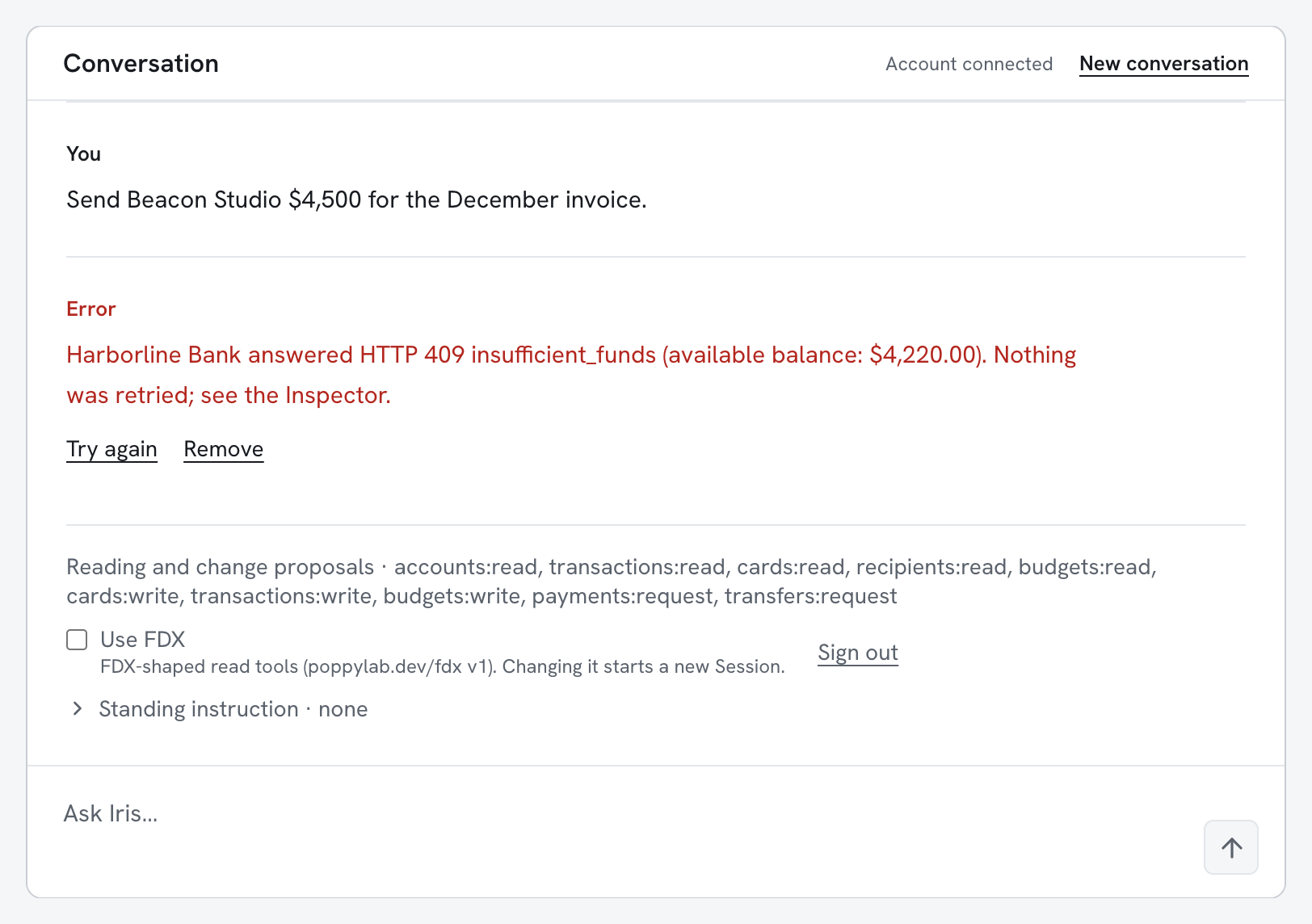
Harborline refused the payment and gave its reason. Iris did not try again. By now Elena has paid Beacon Studio a larger invoice and moved more money to savings, and checking holds 4,220 dollars. She asks Iris to send Beacon Studio 4,500 dollars.
Harborline refuses. There are no terms to approve this time, because the bank does not offer a payment the account cannot cover. Iris shows the bank's answer as an error that names Harborline, its reason,
insufficient_funds, and the balance that was available. It says that it did not try again, and nothing moved.Harborline has limits of its own too. A payment of 6,000 dollars to Beacon Studio was refused with the reason
recipient_limit_exceededand that recipient's limit of 5,000 dollars. One transfer moves at most 2,500 dollars, and Harborline tells agents so. When Elena asked for a transfer of 3,000 dollars, Iris told her the limit and sent nothing to the bank.What travelled
Iris sent the same kind of request as in step 8 to
/api/account/payments. Harborline answered with status 409, the codeinsufficient_fundsand the available balance, and Iris did not repeat the request. The Inspector lists the refusal:POST /api/account/payments · refused by the Company · HTTP 409 insufficient_fundsHarborline gave the same answer when Elena approved a payment of 4,000 dollars after another transfer had left 3,220 dollars in checking. The proposal stayed in the panel, and under its terms the card carried the bank's answer:
Harborline Bank refused this request (HTTP 409, insufficient_funds; available balance: $3,220.00). Nothing was performed.Step 11 shows Harborline's own record of that payment.
See what the agent did
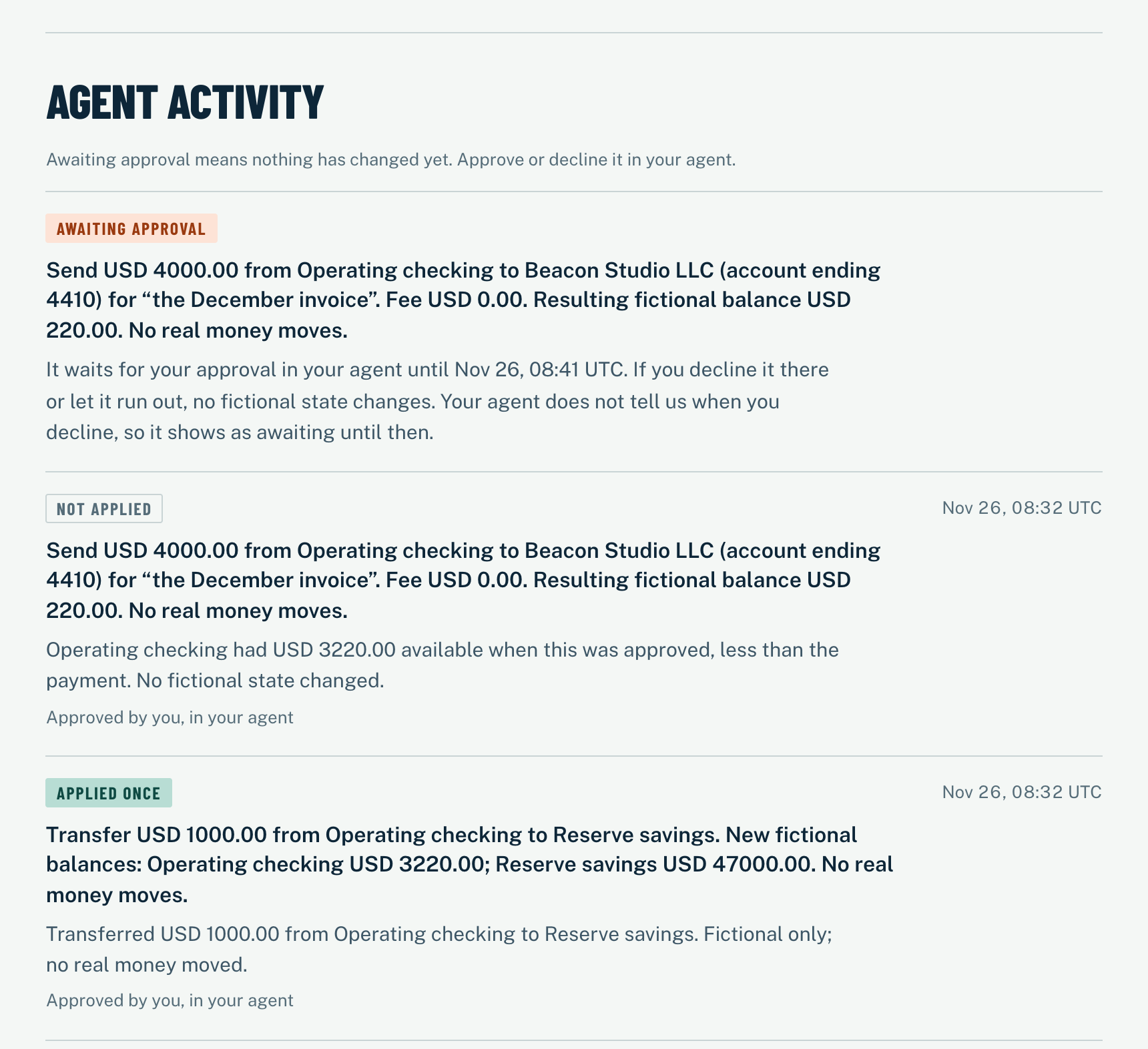
Harborline lists what the agent asked for, what became of each request and who approved it. Lower on its account page, Harborline lists what Elena's agent asked for and what became of each request. A request it carried out is marked Applied once, with the time and the line "Approved by you, in your agent". The transfer of step 6 and the payment of step 9 are further down the same list, each applied once.
The screenshot was taken shortly after the refused approval described in step 10. The payment of 4,000 dollars is there twice. One entry is marked Not applied, with the time, who approved and the reason in words: checking had 3,220 dollars available when Elena approved, less than the payment. The other is the proposal itself, which still awaits approval because its terms stay open until their time runs out. Harborline then marks it Expired without change.
The money movements themselves stay in the account's history, as in step 9.
What Harborline controls
Harborline stays in charge of the money throughout.
- The sign-in and both consents happen on its own pages, and it decides how the permissions are split.
- It computes the terms: the amount, the accounts or the recipient, the fee and the balances that result. The agent cannot propose a balance.
- It moves money only when the customer's approval arrives, and only for the terms it offered.
- It refuses what its own rules do not allow, such as a payment the balance does not cover or one above a recipient's limit, and it gives a reason.
- It sets the limit on a transfer and tells agents what it is.
- It keeps the accounts and the history of what moved, and it shows the customer what the agent asked for and who approved each request.
For the technical reader
Approvals with Operations explains the approval and what a company checks before it acts, and One task, request by request shows an approved request and its response written out.