When the company can't do it
Elena was given a gift card for Lantern Noodle Bar and asks Iris, her personal agent, to pay for her Friday order with it. Lantern does not offer that to agents. Iris says so, tells Lantern what its customer wanted, and passes on the other way Lantern suggests.
This page follows that request screen by screen, on Iris's side and on Lantern's, and ends with how another company answers a report. Every screenshot is from the live lab, taken on 26 November 2026.
Who does what
| Who | What they do in this process |
|---|---|
| Elena, the customer | Asks for what she wants in her own words and reads the answer. |
| Iris, her agent | Reads the list of tasks Lantern leaves out, and reports a task it could not do, described without naming Elena. |
| Lantern, the company | Chooses what agents can do, lists what it leaves out, takes the report and answers with another way to do it. |
Step by step
See what Lantern leaves out
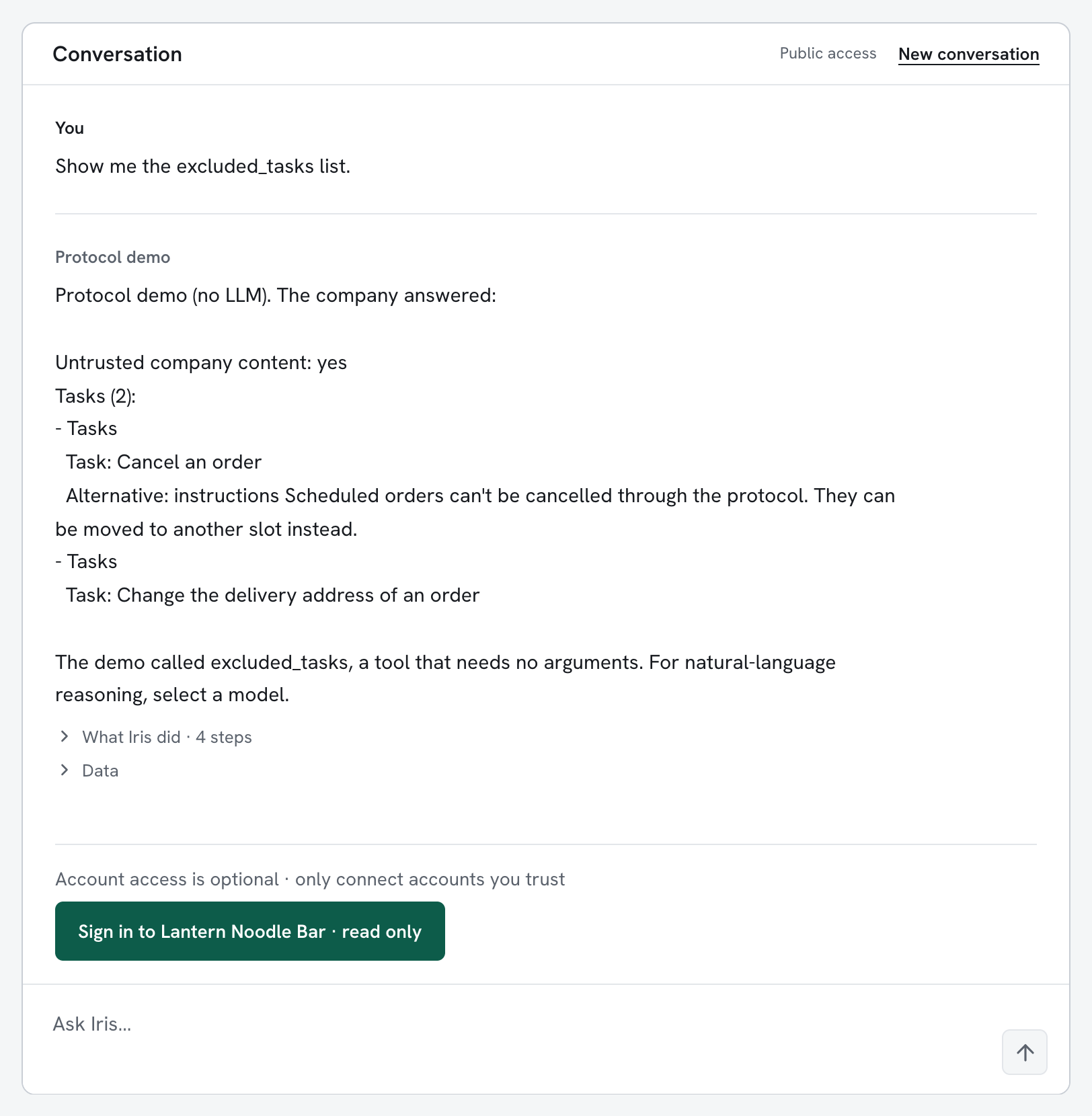
Lantern publishes the tasks it chose to leave out, and for one of them it suggests something else. A company decides what a customer's agent can do with it, and it can also say what it decided to leave out. Lantern lists two such tasks. An order cannot be cancelled through an agent, and for that one Lantern suggests moving the order to another slot. The delivery address of an order cannot be changed either, and Lantern gives no suggestion for it.
Iris reads this list at the start of every session with Lantern, so it knows the answer to these two requests without trying them. The lab runs here in demo mode, without an AI model, which is why Elena has to name the list to see it. With a model connected, Iris checks the list itself before it looks for a way to do an unusual task.
What travelled
Iris opened a session with Lantern and read the address Lantern publishes for its tasks. No account was involved, because the list describes Lantern and says nothing about a customer.
Started a Poppy Session, signed out
Read /poppy/tasks
Found 5 API tools at the Company
Lantern's answer, as Iris received it:
{
  "tasks": [
    {
      "task": "Cancel an order",
      "alternative": {
        "instructions": "Scheduled orders can't be cancelled through the protocol. They can be moved to another slot instead.",
        "references": [
          {
            "type": "openapi",
            "url": "https://food-demo.poppylab.dev/openapi.json",
            "operation_id": "change_order"
          }
        ]
      }
    },
    { "task": "Change the delivery address of an order" }
  ]
}
One task, request by request shows the request itself.
Ask for something Lantern can't do
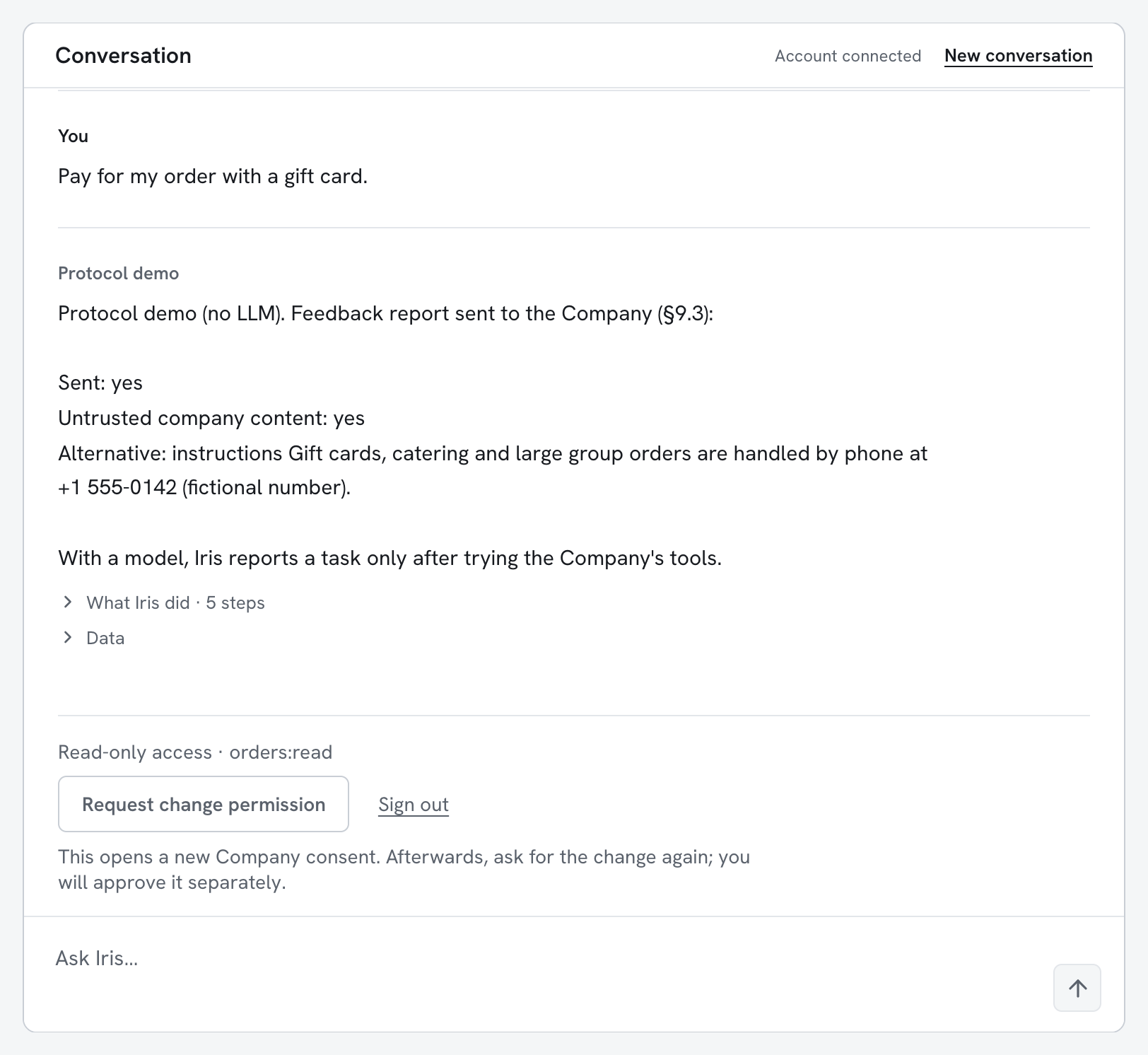
Iris could not do it, told Lantern, and passed on what Lantern answered. Elena has signed in at Lantern, as in Changing an order, and asks Iris to pay for her order with a gift card. Paying with a gift card is on neither of Lantern's lists: none of the things Lantern lets an agent do applies one, and Lantern has not said that it leaves the task out.
Iris does two things. It tells Elena that it cannot do this at Lantern, and it sends Lantern a short report of the task. Lantern answers the report with another way to do it: gift cards are handled by phone. Iris shows that answer as Lantern's words. The line "Untrusted company content" marks it as something the company wrote, which Iris passes on and does not take as an instruction.
In demo mode the report is a fixed one, sent as soon as the message mentions a gift card. With a model connected, Iris reports a task only after it has tried the tools Lantern offers.
Read what Iris told Lantern
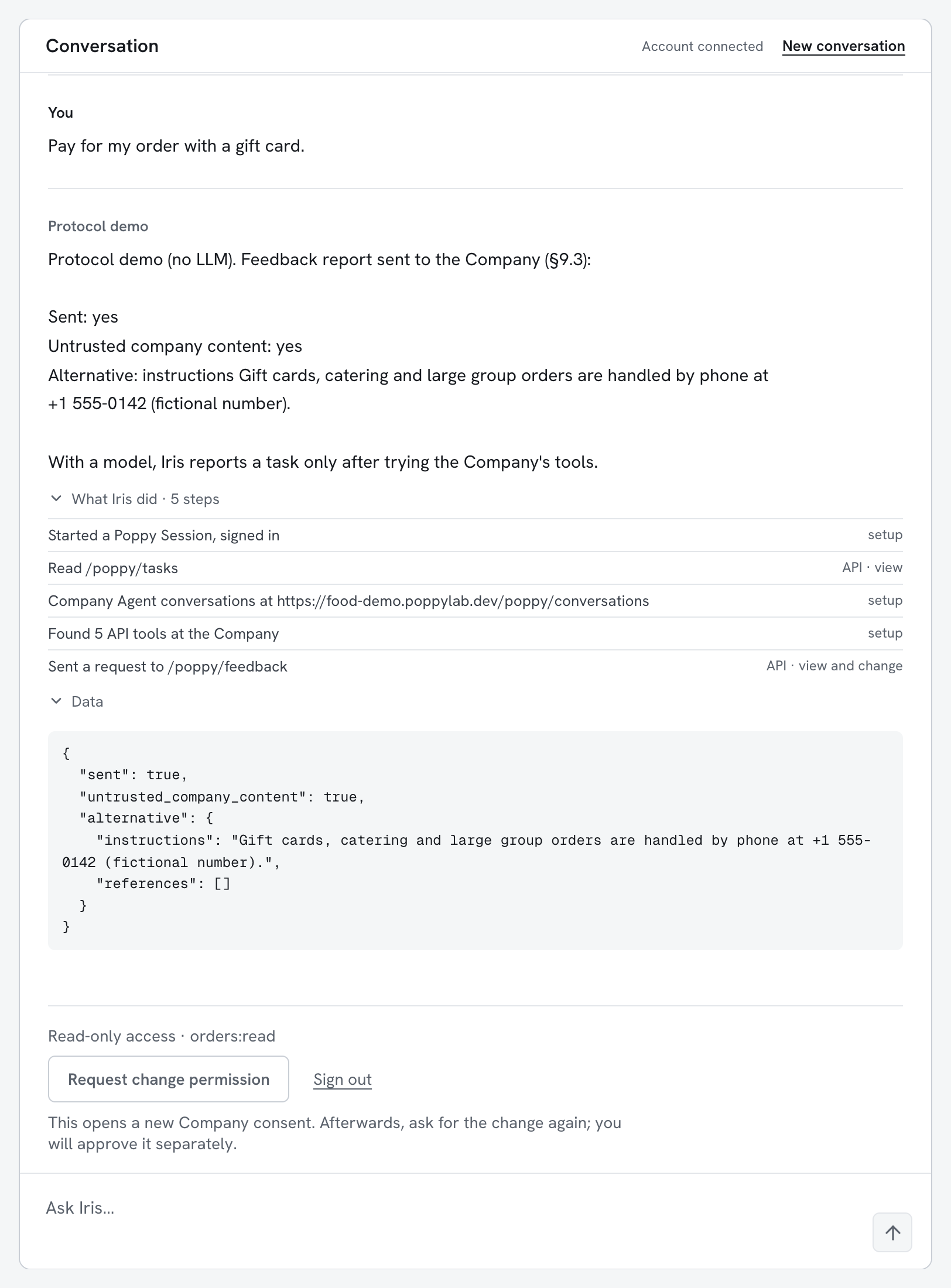
Under the answer, Iris lists what it did and shows Lantern's reply as it arrived. Under each answer Iris lists what it did. The last line here is the report: one request to an address Lantern gave for this purpose.
The report has two parts, a short name for the task and a description of what was wanted and why it could not be done. It describes the task and leaves Elena out: it holds no name, no contact details and no order number. Iris checks the text before sending, and a report that seems to contain an email address, a phone number or a reference is held back.
What travelled
The report, as Iris sent it:
POST https://food-demo.poppylab.dev/poppy/feedback{ "task": "Pay with a gift card", "description": "The User wanted to pay with a gift card they were given. None of the Company's APIs or its agent's requests apply a gift card." }Lantern's reply:
{
  "instructions": "Gift cards, catering and large group orders are handled by phone at +1 555-0142 (fictional number)."
}
The request went in Iris's session with Lantern, so Lantern knows which agent sent it. Elena was signed in, so it also carried her permission for Iris, and Lantern can file the report under her account. Feedback, on the wire lists the rules for the company, and Feedback reports those for the agent.
Find the report at Lantern
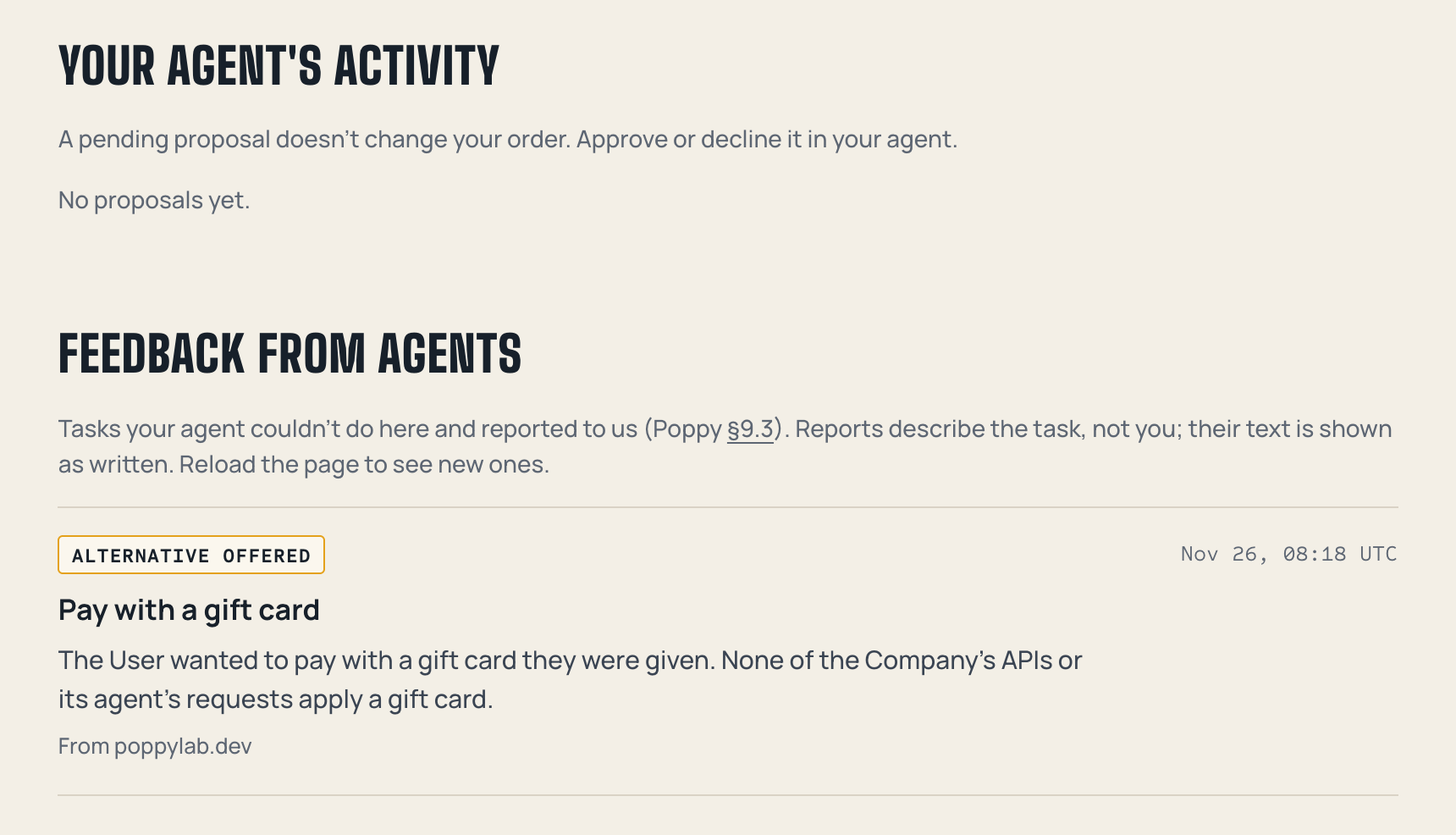
Lantern's own website shows Elena the report her agent sent, word for word. On Lantern's website, Elena's account page has a section called Feedback from agents. The report is there as Iris wrote it, with the time, the agent it came from and a note that Lantern offered an alternative. The section above it shows that Iris proposed no change to her order.
The report now belongs to Lantern. It tells the company that a customer wanted to pay with a gift card through an agent and could not. What Lantern does with that is its own decision: it can offer the task to agents later, or keep answering with the phone number.
Ask again
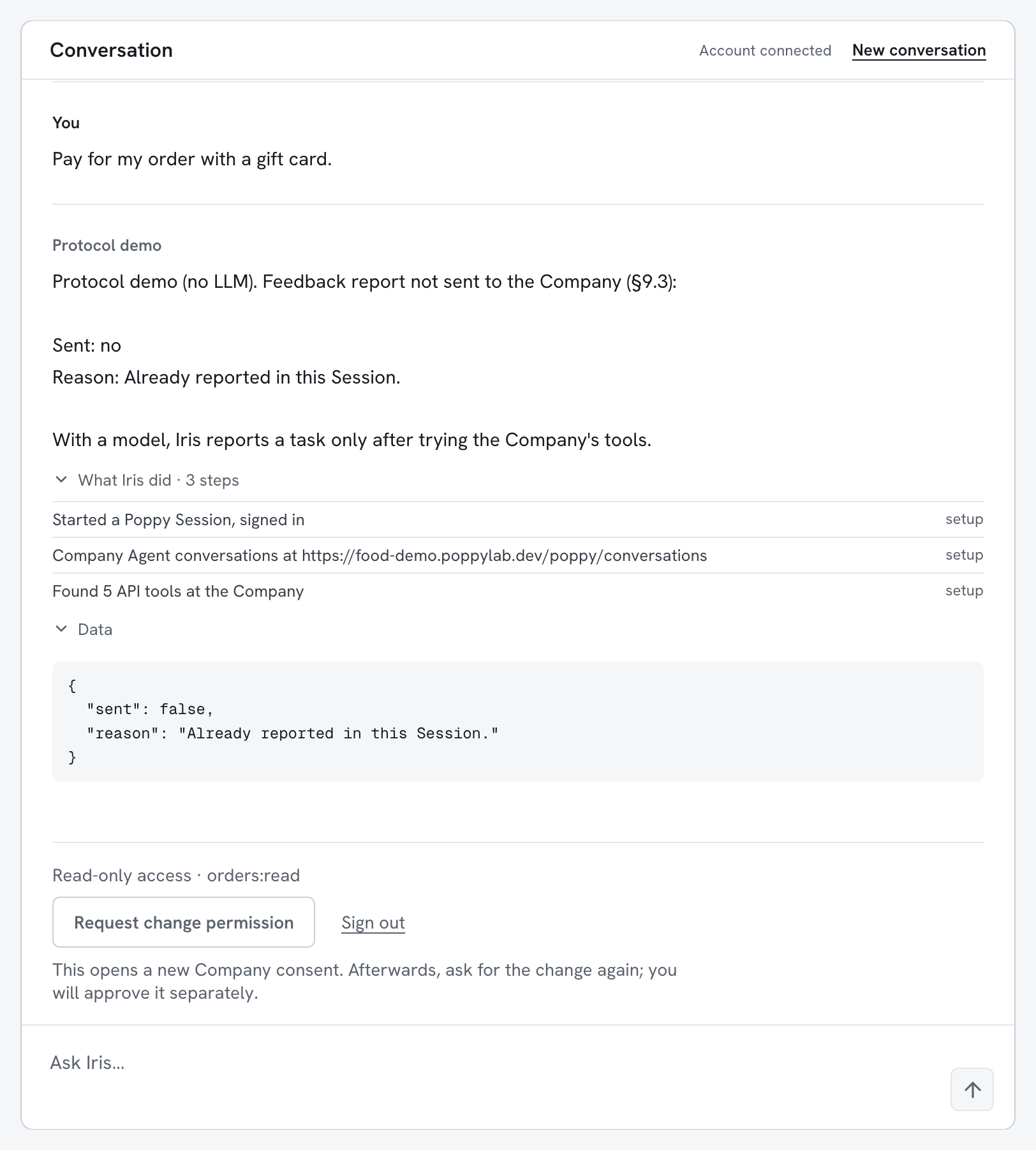
Asked a second time, Iris does not send the report again. Elena asks the same thing a second time. Iris does not send a second report. The answer says so in its heading and gives the reason under it: the task was already reported in this session. The list of steps has no request to Lantern's feedback address this time.
Within one session Iris reports a task once, however many times Elena asks. The protocol asks an agent for one report for each task it could not do, and none for each further attempt.
Another company answers every report
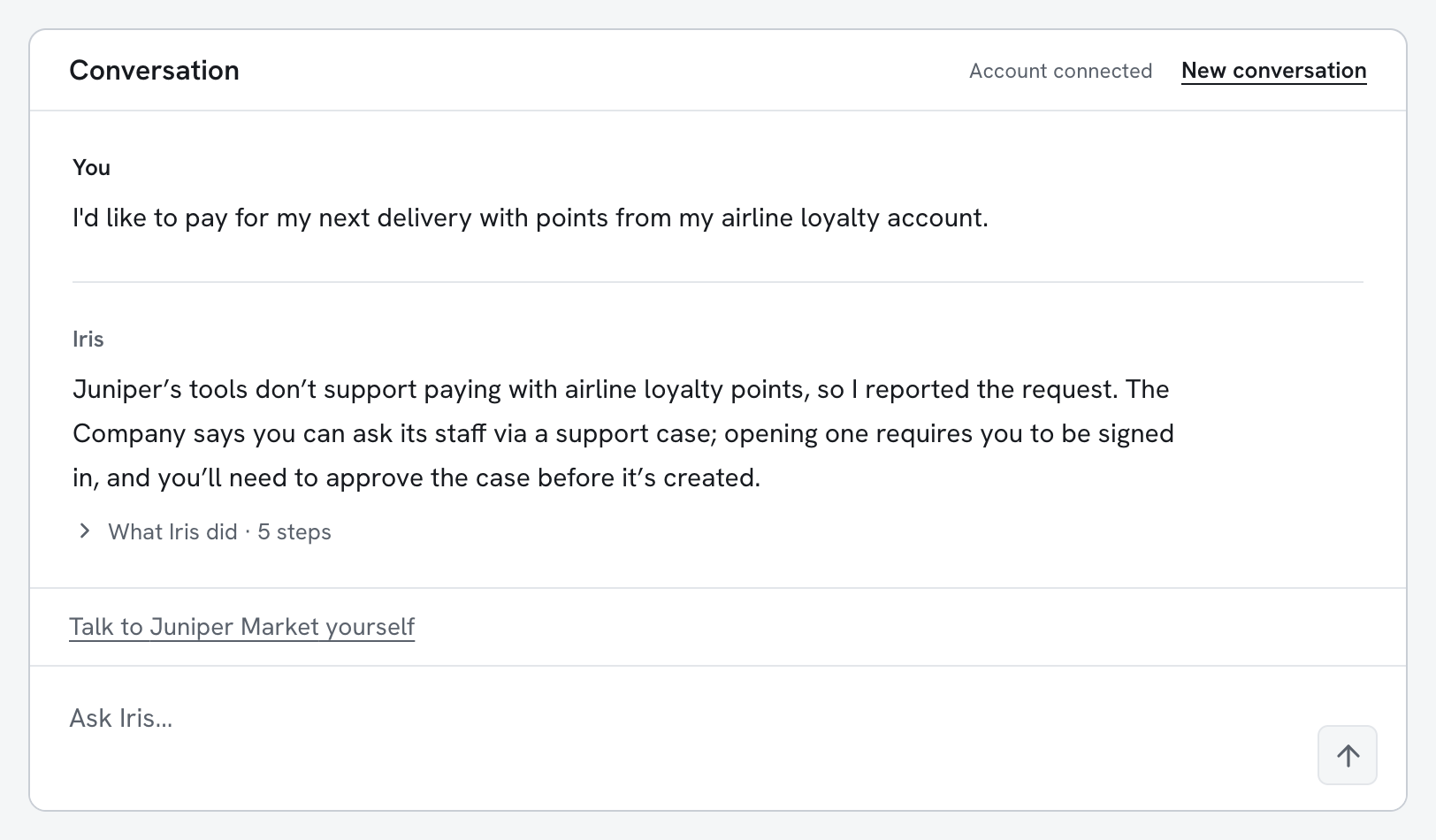
Juniper answers a report it does not recognise with a general way forward. Lantern answers the reports it has an answer for and acknowledges the rest. A company can also answer a report it does not recognise with a general way forward, and Juniper Market does. Elena asks Iris to pay for her next delivery with airline points, and Juniper answers the report: its staff can take the request up in a support case.
This step uses an AI model, where the rest of the page uses the demo's rules. The demo sends only the gift-card report, which Juniper recognises and answers with a phone number. With a model the label on the messages reads Iris, and Iris gives Juniper's answer in its own sentences.
What travelled
Iris's steps for the first message end with the report. The Inspector lists it as "POST /poppy/feedback · feedback · 200 with an alternative".
Started a Poppy Session, signed in
Read /poppy/tasks
Company Agent conversations at https://grocery-demo.poppylab.dev/poppy/conversations
Found 19 API tools at the Company
Sent a request to /poppy/feedback
The model wrote the report. Juniper's website shows it as it arrived: the task "Pay with airline loyalty points" and the description "Use points from an airline loyalty account to pay for the next delivery."
The protocol's validator also sends Juniper a report that Juniper does not recognise and checks the alternative that comes back. The validator results record that run.
Find the report and the case at Juniper
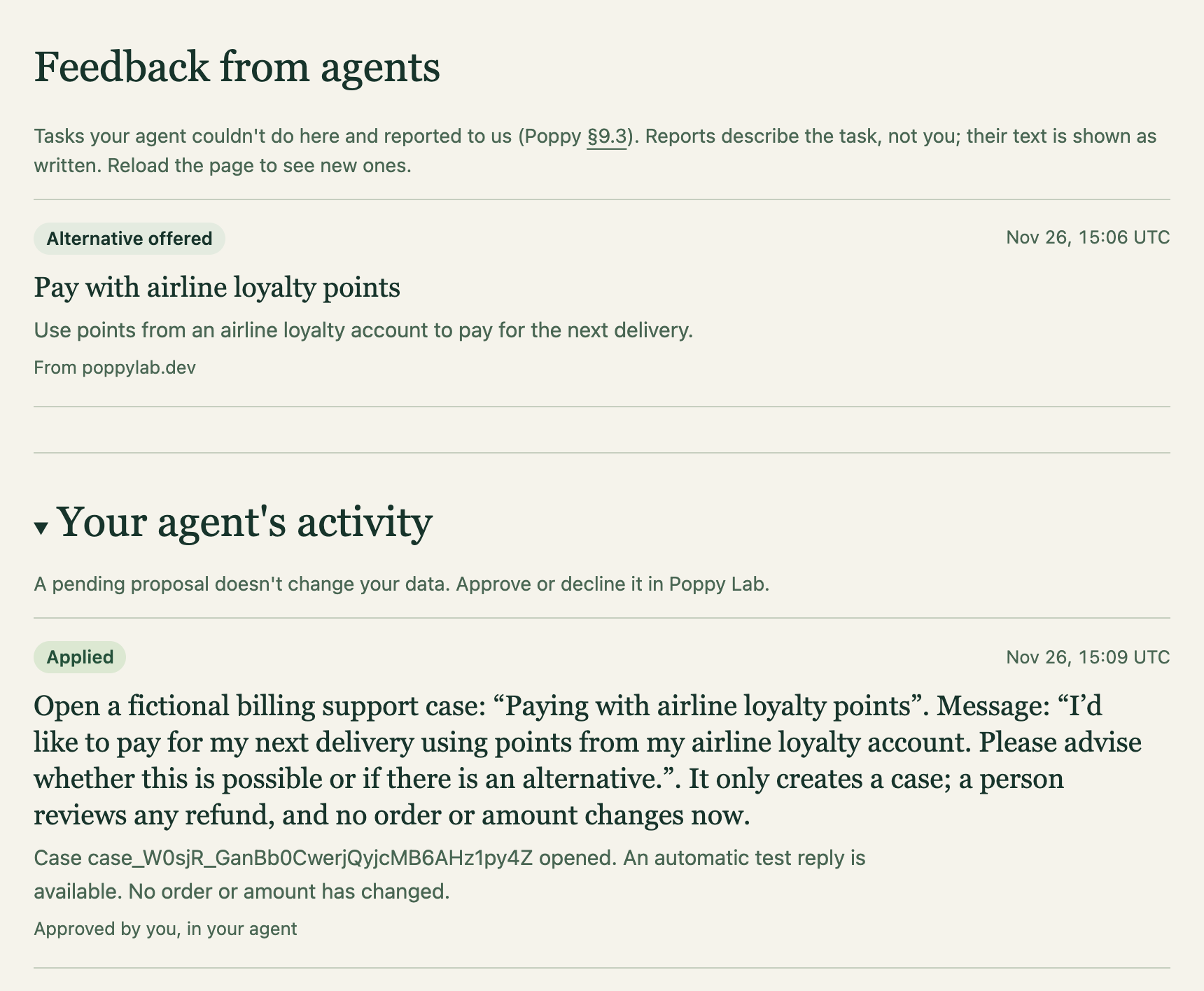
Juniper's website shows the report and the support case that followed it. Elena asks Iris to open the case. Juniper proposes it with its exact words, and she approves it in Iris.
Her account page on Juniper's website then shows both. The report is under Feedback from agents, marked Alternative offered, and the case is under Your agent's activity, approved by her in her agent.
What Lantern controls
Lantern decides what its customers' agents can do, and it hears about what they could not.
- It chooses which tasks an agent can carry out and which need the website, the phone or a person.
- It publishes the tasks it left out on purpose, with a suggestion where it has one, so that an agent does not spend time looking for a way.
- It decides whether to take reports at all, and where.
- It answers a report with another way to do the task when it knows one, in its own words.
- It keeps the reports and decides what to do with them.
For the technical reader
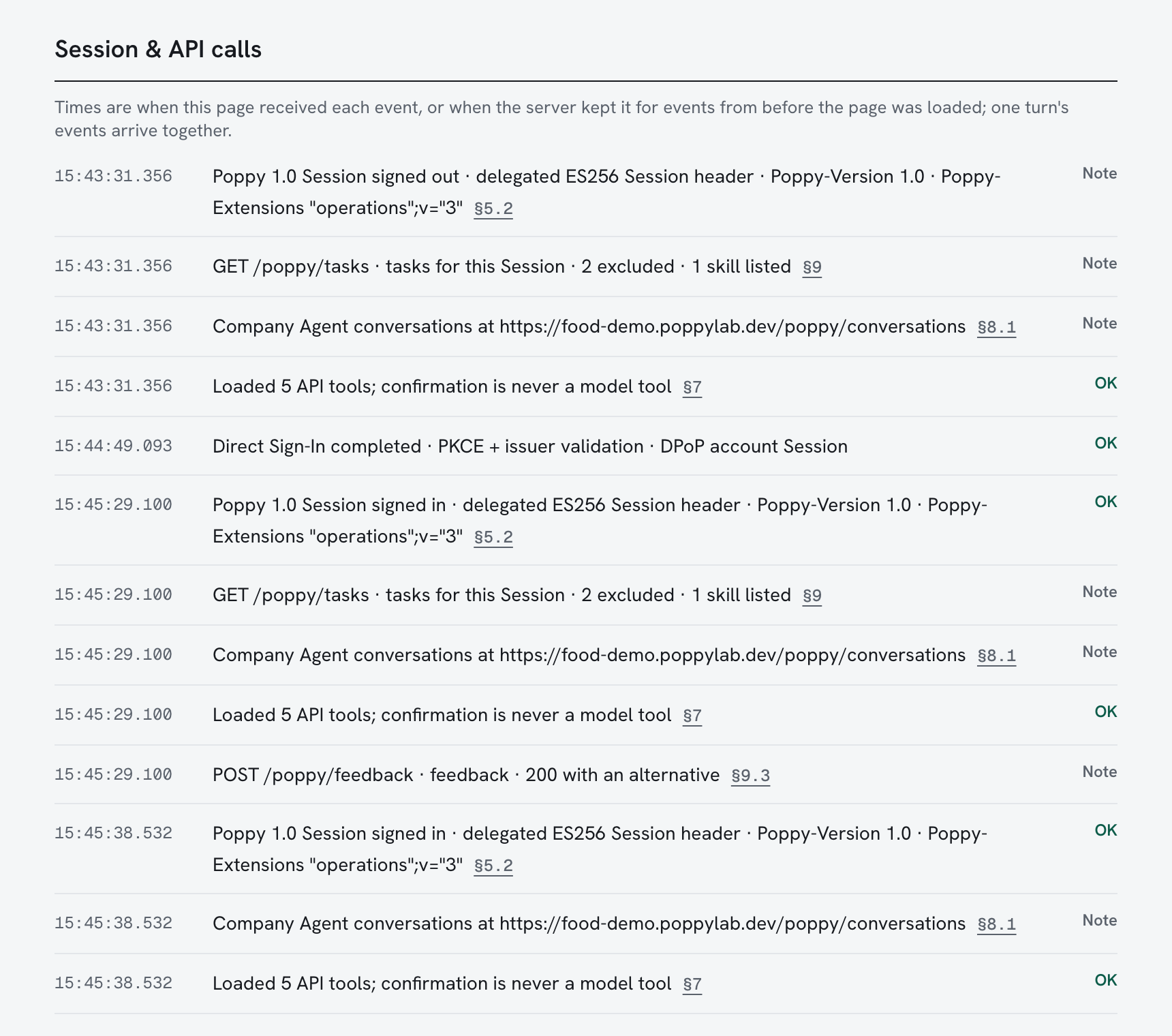
The Inspector view of the playground lists the read of Lantern's tasks and the report with its result, "200 with an alternative", each beside the section of the specification it follows. From the first message of a session on, its Company profile names the two tasks from step 1 under Tasks not offered. Under Skills published it names the note Lantern wrote for agents on changing a scheduled order, which Iris lists and does not load yet. Build a Company shows the request and both possible answers, and section 9 of the specification defines excluded tasks, alternatives and feedback.